


Ameya360: Fibocom’s MediaTek-based <span style='color:red'>5G</span> Module FG370-EAU
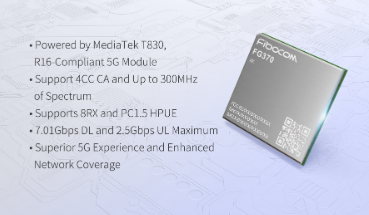
  Fibocom FWA-dedicated 5G module FG370-EAU has received CE and GCF certifications successfully. With its high performance and extended capabilities, FG370-EAU is set to empower a various of FWA devices such as:CPE, IDU, ODU, MiFi, UFi, Dongle, etc.   Fibocom Wireless Inc., a global leading provider of IoT (Internet ofThings) wireless solutions and wireless communication modules, announces that the FG370-EAU 5G module has received CE and GCF certifications in December 2022. Fibocom FG370-EAU is a FWA-dedicated 5G module designed to provide ultra-reliable connectivity to FWA devices such as: CPE, IDU, ODU, MiFi, UFi, Dongle, etc. It is now fully capable of boosting the global FWA market by receiving both certifications, accelerating the worldwide deployment of FWA devices.  Compliant with 3GPP Release 16 (R16) standard,Fibocom FG370-EAU based on MediaTek’s T830 chipset platform is designed to empower the 5G FWA market worldwide. By leveraging the powerful quad-core Arm Cortex-A55 CPU, FG370-EAU supports 4CC CA (Carrier Aggregation) and up to 300MHz of spectrum, as well as 2CC CA and up to 200MHz of spectrum, which improves the utilization of spectrum resources and ensures an extended 5G coverage. Helping customers to improve the device performance and enhance 5G network experience.  It is worth mentioning that the 5G Sub-6GHz module FG370 supports 8RX (Receive Antennas) and Power Class 1.5 (PC1.5) High Power User Equipment (HPUE), significantly improving data transmission performance up to 7.01Gbps on the downlink and 2.5Gbps on the uplink. With the enhancements, FG370 is featuring to offer three combinations for FWA application scenarios, unleashing the extreme wireless experience and consistent low latency.  5G Cellular + Tri-band 4×4 Wi-Fi 7 (BE19000) for 5G IDU Solution  5G Cellular + Dual-band 2×2 Wi-Fi 7 (BE6500) for 5G ODU Solution  5G Cellular + Ethernet 10Gbps for Wired Solution  “Obtaining the CE and GCF certifications ensures Fibocom’s commitment to provide the best-in-the-market products and solutions to our customers worldwide,” said Simon Tao, General Manager of MBB Product Management Dept., Fibocom. “Fibocom FG370-EAU is one of the most selected solution by major FWA device vendors in the global market, with continuous efforts, we believe that we will help customers to achieve great success in future.”  The engineering sample of FG370-EAU is now ready for international shipping.
Release time:2023-02-14 15:00 reading:3144 Continue reading>>
AMEYA360:IoT, AI and <span style='color:red'>5G</span> Bring Actionable Intelligence to the Factory Floor
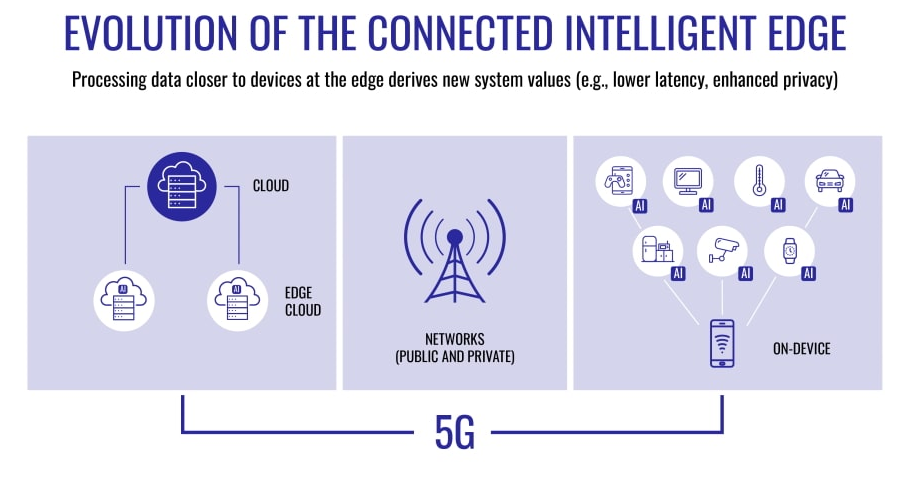
  In my inaugural blog last year, I reflected on the Renesas Renaissance in terms of how our long-term growth strategy is positioning the company as a full-spectrum, global technology solutions provider with an extended physical footprint in the U.S., Europe and China. Thanks to the acquisitions of Intersil, IDT, Dialog Semiconductor, and Celeno we now have expansive design capabilities that surround our market-leading embedded processor expertise with four core analog and mixed-signal competencies: sensors and sensor signal conditioning, connectivity, actuation and power management.  In each case, these companies and their engineers and scientists are contributing significantly to our key growth objectives, with overall revenue increasing at a CAGR of 17.7% between 2019 and 2021 and operating margin growing 16.9% over the same period. Perhaps most telling is the fact that, between 2020 and 2022, our infrastructure and industrial businesses grew by 33% and 37%, respectively, while our internet of things (IoT) segment saw an astounding 79% jump (37% organically) in CAGR.  That the industrial IoT (IIoT) marketplace is expanding at such a torrid pace is not surprising. For Renesas it signals an opportunity to accelerate adoption among our customers and ecosystem partners by enabling the convergence of three key technology areas that are maturing at roughly the same time: IoT, 5G connectivity and artificial intelligence (AI). We call this AI IoT, or AIoT, and the trend is driving a shift in how we collect, store, process, distribute, secure and power data in order to turn it into actionable intelligence we can learn from.  Evolution of the Connected Intelligent Edge: Processing data closer to devices at the edge derives new system valures (e.g., lower latency, enhanced privacy)  Such a sea change entails a move away from centralized, cloud-based architectures to distributed, edge-based designs that use tiny machine learning (ML) nodes like MCUs and MPUs to define the endpoint, accelerate mathematical models and improve the performance of deep neural networks.  While many people might associate AI with futuristic consumer applications like robotic assistants, the fact is that much of the initial impact will be felt in the industrial space where when IoT endpoint node creation is exploding at an 85% CAGR (2017-2025), yielding an almost unfathomable 73 zetabytes of data, according to IDC. From an applications perspective, these growth lines will open new markets and revenue channels in areas such as predictive maintenance, rapid defect detection, biometric recognition and asset tracking to name just a few.  That’s what led us to one of our most recent and significant 2022 acquisitions – Reality AI. The company is especially strong in developing algorithms for the industrial space, which is helping to fulfill our long-term vision of combining advanced signal processing and mathematical modeling with AI to build machine learning models that we can implement on our embedded processors – from 16 to 64 bits.  The Reality AI acquisition is an important component of realizing our AIoT vision, which this year also included investments in companies like Syntiant and Arduino that are extending our reach into more complex use cases, as well as a platinum sponsorship with the Tiny ML Consortium.
Key word:
Release time:2023-01-30 13:31 reading:2364 Continue reading>>
Ameya360:Will GaN Technology Close the Performance Gap for <span style='color:red'>5G</span> mmWave
  There is no doubt that 5G’s higher bandwidth, lower latency and higher availability make it well suited for a range of applications. However, the higher-frequency bands, particularly millimeter-wave (mmWave), also bring challenges around delivering these improvements. As a result, power IC manufacturers are looking at more efficient technologies, such as wide-bandgap (WBG) semiconductors like gallium nitride (GaN) and silicon carbide (SiC), to enhance performance and lower costs in these new networks.  What does the mmWave band bring to the table? First, it expands the spectrum for wireless data communications, which helps increase the amount of data that can be transmitted and lowers latency, and secondly, it is ultra-fast. Yet industry players said that to deliver high, 20-Gbits/s data rates of 5G, the mmWave spectrum will need to be rolled out.  However, mmWave has several drawbacks: an ultra-short range and the signals easily being blocked by things like buildings, walls, trees and even adverse weather conditions like rain.  The real benefits of 5G mmWave are high download speeds and low latency, but the downside is poor signal propagation because of the higher frequency, making it easily blocked by windows and walls, and general distance makes it more difficult propagation-wise, said James Edmondson, senior technology analyst at IDTechEx.  While silicon technologies like traditional LDMOS semiconductors still provide high performance at lower frequencies, WBG semiconductors like GaN-based amplifiers that can handle up to the 100-GHz range will be needed for mmWave frequencies. GaN semiconductors already offer benefits in the sub-6-GHz range, leveraging its higher density and efficiency and lower parasitic capacitance. But there are still some developmental challenges that GaN presents before it can be fully adopted into mmWave networks.  5G comes in two flavors: sub-6 GHz that supports mid (about 3.5 GHz to 7 GHz) and low (<1 GHz) frequencies, now being deployed in mobile networks, and the ultra-high–frequency band (mmWave), typically noted as between 24 GHz and 100 GHz, which is still at the very early stage of development.  Most of the 5G deployments today are based on sub-6 GHz, according to IDTechEx, due to its high throughput and cost. Despite its ultra-fast speed, mmWave is still too expensive to deploy and it has disadvantages around line of sight. About 1 million mmWave antennas are currently deployed, according to the market research firm, with a forecast of 50 million by 2033.  What will speed up 5G mmWave deployment?  Although many industry players say it is simply too early for 5G mmWave deployments, mostly because of cost, GaN power devices will play a role in developing more cost-effective networks and achieving the promise of 5G.  One of the roadblocks to fast-tracking 5G mmWave is a lack of market demand. “When 5G was first talked about, there were a lot of these killer potential applications like remote surgeries and the metaverse, but not all of that has taken off yet, so there is a bit of a market pull lacking at the moment,” said Edmondson.  GaN RF power IC suppliers like NXP Semiconductors also cited the lack of demand as a challenge. NXP offers a wide selection of RF power devices, including GaN-on-silicon, silicon LDMOS, silicon germanium (SiGe) and gallium arsenide (GaAs) technologies.  “What we saw is a lot of hype and interest because of these enormous swaths of bandwidth that became available, and there was a lot of initial excitement with everyone rushing to get products out, including NXP,” said Geoff Tucker, director of RF systems engineering in the Radio Power business unit at NXP Semiconductors. “It kind of fizzled a little bit when it came to actual shipments. I think it still has a role in networks, but as of yet, it doesn’t seem like it’s truly found its niche, whether it be for a mobile technology or fixed wireless access.”  However, how this technology evolves, given the large pieces of spectrum, which is the gold of the industry, and where that might be going is of interest to NXP, he added.  Despite the lack of market demand today, power IC manufacturers are working to solve the biggest technology challenges, including higher integration, to deliver high-efficiency power amplifiers, which will be needed to reduce power consumption and shrink form factors in radios and antennas. GaN-based devices are at the top of their list. Although most of them are working with GaN-on-SiC, there is some work under development for GaN-on-silicon for mmWave.  Yole Intelligence reports a lot of activity around GaN-on-silicon. “The company OMMIC is proposing GaN-on-Si beamformers for 5G mmWave, and this solution is expected to be seen penetrating the market in the coming years,” said Cyril Buey, technology and market analyst for RF Devices and Technologies at Yole Intelligence, part of Yole Group. “We also see the startup Finwave developing FinFET GaN-on-Si for mmWave technology, as well as STMicroelectronics and GlobalFoundries working on GaN-on-Si devices, so a lot of activities on GaN-on-Si.”  However, Yole is less optimistic about GaN-on-SiC devices for 5G mmWave. “Qorvo has a portfolio of GaN-on-SiC power amplifiers in mmWave frequencies, but for now, at Yole Intelligence, we don’t see 5G mmWave products using GaN-on-SiC devices,” he added.  Buey thinks there is room for GaN-on-Si for 5G mmWave applications but not for GaN-on SiC, mainly due to the high level of integration needed for mmWave devices. “In the end, GaN-on-SiC might be suitable for backhaul applications, also at mmWave frequencies, where the system architecture is simpler.”  Why GaN for mmWave?  It is well known in the industry that SiC and GaN offer several advantages over silicon power devices, including lower switching and lower conduction losses. SiC also offers reduced thermal management, while GaN delivers higher switching frequencies.  The primary advantage of GaN is its higher power density, which allows for a smaller-form factor and thus a reduction in overall system size, at the same performance. This can benefit mmWave base stations by allowing a signal to be transmitted with more power, translating into a wider coverage area.  LDMOS is good up to 4 GHz, but above that, it starts to become quite inefficient to operate, said Edmondson. “The big challenge for GaN, especially initially, was more toward the cost of the material, so silicon technology is very mature and very cheap. But because of the high power density, you can get away with using a lot less material, so there is somewhat of a tradeoff. Typically, GaN has been more expensive, but also on top of that, there is a general lack of industry experience with the material.”  “There are some physics involved here, but what GaN does is concentrate more of the power into a smaller area to achieve the same goal from the amplifier, and therefore, it is a nice technology to help us densify the overall designs,” said Tucker. “You still have to put all the other analog functionality in there—switches, gain blocks, attenuators and whatever else we decide to throw in a given amplifier—but it does help us to miniaturize things if it can be done successfully.”  The biggest challenges of mmWave around line of sight, range and signal propagation (high losses) will need to be solved. Some of the answers will require changes in the RF circuitry and power amplifiers, although there are technologies like massive MIMO, miniature antenna arrays and smart active repeaters being used to resolve some of these issues.  “When you move to mmWave, the antennas shrink, which increases your power density per device, so the actual number of antenna elements within a device increases a lot,” said Edmondson. “You can be looking at thousands of antenna elements in a package, and what that actually means is that the power demand on each individual amplifier goes down. I think that’s been a big reason why we haven’t seen GaN adopted significantly in mmWave 5G yet. If you can get away with using the existing silicon technology, then that’s probably going to be the easier way to do it.  “There will be more adoption of GaN in the future in mmWave, but it does face some extra challenges like component integration and the fact that there’s actually less power demand on each individual amplifier,” he added.  Ultimately, the choice of technology—silicon- or WBG-based—comes down to the application. “For an antenna design, it’s the specifications of the amplifier that is going to sell it to me,” said Edmondson. But at the same time, if the GaN device requires extra work around mounting it on the board or dealing with thermal management, those are obviously design tradeoffs, he added.  The No. 1 design challenge is the architecture of the radios themselves and what feature sets get put into them because it is still at the very early stage, said Tucker.  First-generation radios are purely linear in nature, and the amplifier final stages don’t take advantage of high-efficiency techniques that are found elsewhere in the industry, Tucker said. “That’s slowly changing, where you start to see higher-efficiency architectures and digital predistortion coming online for these higher-frequency radios, but still, it’s very simplistic. It’s not nearly as mature as well-established communication systems.”  There is a trend toward higher power and fewer transmit paths, which is important when it comes to GaN and what it can actually do with high frequencies, he added.  Tucker also noted cost as a design challenge. “We see a simplistic architecture being employed for these mmWave radios that are purely analog beamforming, which is probably not the preferred way to do it. It’s certainly not what we use at sub-6 GHz.”  The reason is simple economics, Tucker explained. These high-order types of transmitters have a lot of analog functionality with a lot of integration and pairing with digital front ends that are used in modern radios, he added.  GaN-on-SiC, which NXP uses today, will be very competitive and work extremely well at up to 30–40 GHz, but beyond 40 GHz, you will start to lose some of that “superb” efficiency, said Christopher Dragon, director of device engineering in the Radio Power business unit at NXP Semiconductors.  Despite some challenges in the higher-frequency ranges, Dragon believes GaN-on-SiC will still have a play based on research in the industry that is looking to extend the frequency range. One area of research and discussion is N-polar GaN-on-SiC. “I think the research will lead us in a direction that will work,” he said.  Silicon LDMOS, which would rule the industry for base stations for years, started to lose its efficiency at about 2–3 GHz, and that is where there is a transition to GaN, Dragon said. “I see that happening [loss in efficiency] with GaN-on-SiC in the 30- to 40-GHz range.”  As the frequency goes up, with all of the parasitics in the device, you start to lose that efficiency, and that is what kills off the usability of the technology, Dragon said. “That is where you’re into problems trying to design power amplifiers. You really need those things to run efficiently and you need them to be linear. The power-added efficiency is going to be what gets you.”  Designers also have to consider thermal management.  “GaN is great: It’s got a lot of power density per millimeter of periphery in the devices and it’s really cranking out the watts, but you’ve got to manage all that heat, which is why the SiC is so important,” Dragon said. “It’s very good normally, but as you approach these mmWaves, there are actually big debates around moving to GaN-on-Si for a couple of reasons. One is that you don’t necessarily need the SiC for the thermals anymore and silicon is going to be much cheaper than GaN-on-SiC.”  “Thermals still are something that need to be strongly considered in these radios because you have an area-per-watt problem that needs to be solved and the thermal design of the entire radio is still very important and a very strong consideration for designers,” added Tucker.  Monolithic microwave integrated circuits (MMICs) will also become more important at those higher frequencies, Dragon said. Integrating all of those different components, making them more repeatable and reliable, will become really important at those higher frequencies, he added.  “At higher and higher frequencies, integration becomes important—we can’t use traditional chip and wire interconnects,” agreed Tucker. “If we were to go take GaN-on-SiC and do a full-blown MMIC type of design, that would be horribly expensive. It would probably be wonderful for the power amplifier but pretty poor for all the other features and functionality that wind up on these chips. So the trick to GaN at a higher frequency is how we can put it together with another technology that supports the other analog functionality that we need in a cost-effective way.”  Whether it will be a chiplet type of approach using GaN-on-SiC die along with a SiGe die or GaN-on-Si integrated on a bigger chip, that all remains to be seen, but these are the sorts of things that are being discussed at conferences and in universities that are doing research to tackle exactly that problem, he added.  “It is more difficult to do, but we will see more of it as we go up higher in frequency, without a doubt,” Dragon said.  “I think GaN has a good place in those mmWave ranges,” he added. “In terms of the R&D aspect, whether it moves over to N-polar or GaN-on-Si because of the integration piece, those are interesting questions, but I think GaN will absolutely be there. But traditional silicon LDMOS types will not be there at all.”
Key word:
Release time:2023-01-30 11:00 reading:2260 Continue reading>>
Ameya360:Tackling RF Design Challenges in <span style='color:red'>5G</span> Rollout
  As 5G technology continues to roll out and offer improved network capacity, design challenges and other hurdles are emerging in the analog front-end space. One significant challenge is a densely-packed radio with multiple transmitters and receivers. Other issues to troubleshoot include operating over wider bandwidths and over several different frequencies. Improved digital twins and RF models also play important roles.  While the challenges may evoke memories of the 4G commercial rollout in 2009, this latest generation poses even more issues to overcome.  “The initial rollout of 5G looks and feels very similar to the current 4G LTE design space, with typical challenges of multiple frequency bands and lots of tough filtering and power requirements,” said Joe Civello, director of RFMW product management and PathWave software solutions at Keysight Technologies. “While this is challenging by itself, it is just the tip of the iceberg for what is coming in 5G. As the higher frequency bands roll out, along with small cell deployments in dense areas, the challenges will increase dramatically. Analog front ends need to operate over wider bandwidths and at several different frequencies, sometimes simultaneously in the case of non-contiguous channel bonding.”  The improvements and the challenges often come in the same package.  “Beamforming [in which a wireless signal is directed to a specific receiving device] is at the core of network capacity improvements offered in 5G, but it presents radio designers with significant challenges,” Peadar Forbes, director of radio platform development at Analog Devices, said. “First, you have a densely packed radio with multiple transmitters and receivers, up to 64 in the case of sub-6 GHz or up to 256 in the case of mmWave radios. The dense packing of transceivers, power amplifiers, LNAs and filters causes significant thermal RF isolation and coupling challenges for radio designers. Secondly, there are a lot of digital circuitries operating at awkward frequencies with the potential to interfere with the radio.”  Along with beamforming, other new 5G technologies including multiple input, multiple output (MIMO) and antenna arrays, will reshape and improve the analog front-end and bring more challenges, Forbes said. The antenna arrays must be calibrated to fine degrees of accuracy, for example, to enable accurate beams—but that adds complexity, he said.  One big unknown is the impact of artificial intelligence/machine learning optimization of the air interface, Civello explained.  “Researchers in academia and industry are looking at the benefits, which can be realized for channel estimation, beam management and positioning accuracy,” he said. “It’s certainly conceivable that this research will drive not only new signal processing technology, but also impact the RF and antenna architectures in a secondary, but significant, way. Exactly what this means is to be discovered.”  Additionally, increasingly broadband over-the-air systems are more prone to the effects of interference from a packed spectrum, and careful system analysis is needed to mitigate this for all potential scenarios, Civello said.  The designer also must manage internal interference from reference sources and oscillators within the overall system in the context of a broad channel, Civello added. System analysis must also include all the power amplifiers’ load pull characteristics as the array scans, interacting with the array active impedance, he said.  The major burden for managing this risk falls across three tiers of the ecosystem: system-on-a-chip (SoC) design houses, RF system integrators and network infrastructure companies, according to Civello. The requirements will flow down from the network companies to the system providers, and then to the RFIC designers, he said.  Achieving a successful 5G rollout  The best way for companies to succeed with the complexity of 5G and future 6G systems, Civello noted, is to build a robust design flow—not just for their own products, but for their customers’ products, as well.  “The more product data can be shared beyond just datasheets and plots, the better these complex SoCs can be integrated into the end products,” he said. “If the SoC suppliers take a design-for-context approach and design and validate their products in the way their customers will use them, the higher the chances are for successful system integration.”  The parallel transmit and receive paths required for these new technologies will compound the challenges of existing 5G front-end architectures, according to Forbes. While these techniques offer significantly improved data rates, they require multiple front-end chipsets to deliver multiple signals.  In turn, this creates challenges of space and power for handset manufacturers. Base station implementations have less constraints on size and power, but for deployment in dense urban and indoor areas, the size and power constraints will present a similar challenge, he said.  Highly directive phased arrays handling multiple users simultaneously can easily scale up to thousands of elements, each requiring an analog front-end to drive the antenna, Forbes added. Then the challenges shift to the system-level architecture and the need for good modeling for 5G designs.  “Accurate RF modeling is necessary to predict the overall system performance. Without this high-fidelity system model, it’s impossible to analyze all the possible design architecture trade-offs to find the optimal solution for a given application,” he said. “Designing for these applications requires simulation using the real modulated waveforms rather than just CW stimulus. Without these waveforms, performance can’t be predicted until lab testing, which is then often followed by troubleshooting and possibly re-design. One way of addressing this is by creating accurate nonlinear models of analog front-end behavior, which can be used in higher-level system simulation tools to exercise the RF portion with not only real waveforms, but also in actual deployment scenarios.”  Power amplifiers, RF transceivers, and antenna tuning for multiple antennas pose additional front-end design challenges, Civello said.  “Power amplifier design in 5G has some of the traditional challenges related to size, cost, power and performance, but there are even more challenges associated with linearity, efficiency, high bandwidth, high temperatures and increased integration,” he said. “It also brings new challenges with frequencies increasing or latency decreasing.”  Traditional flows around sub-GHz, for example, were using laterally diffused metal oxide semiconductor (LDMOS) or gallium arsenide (GaAs) technologies. To cope with the frequency/power dilemma, the use of gallium nitride (GaN) keeps increasing, Civello said.  Designing GaN is not a minor change of technology, however, and brings new technological challenges, such as stronger memory effects or a more precise thermal management for ICs as well as assembly.  “Just trying to solve the thermal challenges in 5G power amplifier design requires new design techniques and access to integrated electrical and thermal simulations because they are interdependent,” Civello said. “When you look at the sum of these requirements, it adds more and more complexity for the designer and solving these requires much more upfront design and simulations.”  Keysight’s answer to multi-vendor tool challenges  One ongoing challenge that Keysight is working to solve, Civello noted, is multi-vendor tools each optimized for one technology, such as silicon ASICs or GaN MMICs, or board-level design that becomes awkward when trying to accommodate multiple technologies with technology stacks and PDKs from dissimilar domains.  “Where Keysight is making progress is in making it possible to glue difficult domains like RF/mmW onto mainstream flows, and still be able to run 3DEM packaging and nonlinear RF and thermal simulations across a whole ensemble,” he said. “Keysight has taken an open approach to these multi-technology flows, allowing best-in-class tools and processes, adding new domains like millimeter wave and high-power phased arrays, but still working through open standards and APIs that preserve choices.”  These challenges must be addressed immediately, Civello warned.  “The time is now,” he said. “The technologies under consideration are groundbreaking and the technical challenges must be researched, otherwise the commercial risks to the roll out of 5G enhancements and later 6G are unacceptable.”
Key word:
Release time:2023-01-19 13:27 reading:2316 Continue reading>>
<span style='color:red'>5G</span> IoT Satellites Countdown for Takeoff
  A startup is ready to launch the first dedicated 5G IoT satellites this year.  Release 17 of the 3rd Generation Partnership Project’s (3GPP) 5G specification has been completed. Companies are starting to use the non-terrestrial networking (NTN) update to that spec to build the first 5G IoT satellites.  Barcelona, Spain-based startup Sateliot plans to be the first satellite operator to put up a 5G IoT constellation. Elon Musk’s SpaceX operation is launching the first Sateliot nanosatellite in February. Sateliot hopes to put another four up in space by the end of this year. The young company expects to have a swarm of 250 units up by the end of 2025.  Sateliot CEO Jaume Sanpera told EE Times that the startup has been working for four years on its IoT nanosatellites. Sateliot has been collaborating with the 3GPP on the NTN 5G specification. “We made more than 17 contributions,” Sanpera said.  The company’s low-Earth-orbit (LEO) satellite will use 5G narrowband IoT (NB-IoT) to connect its satellites to IoT devices on the ground. Originally a 4G standard, the NB-IoT specification was recognized by the International Telecommunication Union (ITU) as part of its IMT-2020 5G standard in July 2020.  The connection between satellites in space and IoT devices on the ground will depend on more than just having 5G-capable satellites in orbit. Chipmakers must also release silicon that will support the latest 5G specification.  “By mid-year, most of the large manufacturers will have Release 17 implemented on their chipsets,” Sanpera said. This means that satellite-compliant 5G IoT devices could be on the commercial market by the end of 2023 and will become more commonplace in 2024.  Sateliot is talking to mobile network operators (MNOs) worldwide about running its service. The startup has already signed on with major MNO Telefónica, which runs services in 15 countries around the globe. “We are talking to 54 other mobile operators,” Sanpera said.  Dean Bubley, founder of Disruptive Analysis, noted that satellite IoT, largely based on 4G LTE technology, already serves remote oil and gas infrastructure monitoring systems, agricultural sensors and shipping containers, and it tracks high-end assets like construction equipment.  “I think 5G and satellite will be more about backhaul and fronthaul, or direct-to-device for phones and maybe vehicles,” Bubley said. He added, however, the possibility of running a 5G NB-IoT connection from a LEO satellite to devices on the ground.  This is exactly what Sateliot is doing. Sanpera notes that there are four or five other startups that are working to deliver similar 5G satellite systems. The CEO did not name these startups.  Sanpera expects to start offering satellite services that allow IoT devices to send out one message a day. The CEO said that he sees one-third of his customers that need that kind of service, another third that want their IoT devices to send a message an hour and a final third that require near-real–time communication.  Sateliot will move from a constellation that can handle devices sending one message a day in early 2023, ramp up to hourly transmissions in 2024 and ultimately move to near-real–time communication in 2025.  The second-generation shuffle  The Sateliot nano units are already set to launch on SpaceX first-generation satellites this year. The Spanish startup will avoid any issues with launch schedules. “Our plan is already booked,” Sanpera said.  The Sateliot launch won’t be affected by the Federal Communications Commission’s (FCC’s) limited approval of 7,500 SpaceX second-generation satellites, which will begin launching this year. SpaceX had originally requested permission to form a new satellite constellation of nearly 30,000 second-generation satellites.  The new SpaceX satellites are “too large for the current rockets,” explained Sanpera. He said the heavy-lift Starship will be needed to deploy the next-generation SpaceX satellites. SpaceX is expected to test its Starship prototype in space this December.
Key word:
Release time:2023-01-10 10:59 reading:2159 Continue reading>>
MediaTek to Win the <span style='color:red'>5G</span> Competition by Alliance and Independent R&D
  The 3GPP standard conference will be held in Taipei, Taiwan, next week. To foster the local 5G supply chain in Taiwan, MediaTek, a key organizer of the conference, strove for keeping the event to be held in Taiwan with the aim of developing universal standards. Huang He-qi, general manager of the design and development department of MediaTek's communication system, pointed out that for the current situation of 5G, MediaTek will adopt the countermeasures of "wide-scale alliance and independent R&D".  The 3rd Generation Partnership Project (3GPP) is a standard organization dedicating to the development of 5G mobile communication in the world. There are more than 200 international companies participate in and even been called the Olympia Committee of communication standards. Because the standard drafting is like a tug-of-war match, major international companies are hoping to stand in a favorable position to seize the opportunity. Huang He-qi described: "It is a kind of competition, and everybody has their own strategies in it."  He pointed out that because each company has its technical position, therefore they will push their own technical proposals in the specifications to win its best interests. Huang explained that by pushing the proposal into a standard, in addition to being able to apply for a patent, it is also beneficial for the company to establish a technical threshold, so that competitors have no way to break through, and thus make their products more competitive.  Facing of this situation, Huang said that MediaTek will take the countermeasure of " wide-scale alliance and independent research" strategy. But he pointed out that the forming alliance is only a short term approach, and more importantly is to build deep technology and with flexible strategies.  MediaTek emphasizes that the development of 5G technology should not be a solo play, but needs to join hands with industrial partners to create an ecosystem.  Huang said that the Release 15 version was released in December last year. This year, it will be adjusted for more detail. The Release 16 version is expected to be announced in March 2020. He revealed that MediaTek is also expected to launch related products in 2020 to meet customer needs.
Key word:
Release time:2019-01-21 00:00 reading:1517 Continue reading>>
Keysight’s <span style='color:red'>5G</span> Conformance Toolset First to Achieve PTCRB Validation for <span style='color:red'>5G</span> NR Device Certification
Keysight Technologies announced that the company’s 5G Conformance Toolset is the first test solution to be approved for 5G New Radio (NR) device certification by PTCRB, a certification forum comprised of select leading cellular operators, accelerating commercial availability of 5G mobile devices across the ecosystem.This milestone was achieved as a result of the extended collaboration between Keysight and Qualcomm Technologies, Inc., a subsidiary of Qualcomm Incorporated, that focuses on verifying the validity and behavior of the radio frequency (RF) and protocol conformance test specifications as defined by the 3rd Generation Partnership Project (3GPP). Conformance tests adopted by certification bodies such as PTCRB help ensure commercial 5G devices comply to the latest 3GPP Release 15 specifications and operate as expected on mobile networks.The Keysight 5G Conformance Toolset, based on Keysight’s UXM 5G Wireless Test Platform, and part of Keysight’s 5G Network Emulation Solution portfolio, supports the first and only 5G RF test case validated to help device manufacturers verify compliance to the 3GPP 5G NR NSA (Non-Standalone) requirements for minimum output power generated by a 5G mobile device in sub-6GHz frequencies.“The PTCRB approval of Keysight’s 5G conformance test solution establishes an important milestone and enables Keysight to help the global mobile ecosystem accelerate 5G product design development and validation,” said Kailash Narayanan, vice president of Keysight’s wireless test group. “Keysight’s close collaborations with market makers and influential participation in standardization organizations have contributed to the realization of this industry-first achievement, facilitating early 5G commercial deployment.”The Keysight 5G Conformance Toolset addresses the device development workflow from early design, to acceptance and manufacturing. The compact solution supports the entire device certification process and scales to facilitate mobile device verification and certification across RF, radio resource management (RRM) and protocol. The toolset enables users to certify new designs across both FR1 (sub-6GHz frequencies) and FR2 (mmWave frequencies).“We’re excited to extend our collaboration with Keysight to help OEMs and mobile operators address 5G conformance requirements,” says Prashant Dogra, vice president, engineering, Qualcomm Technologies, Inc. “Keysight’s leading 5G test solutions are instrumental in accelerating commercial 5G development and rollout.”
Key word:
Release time:2019-01-15 00:00 reading:1556 Continue reading>>
<span style='color:red'>5G</span> Needs New Approach to Security
Planning for security in 5G networks requires a whole new approach compared to previous-generation networks to protect network infrastructure, according to a new technical report on 5G architecture and security published by the U.K. government.With 5G rollouts planned in some form or another around the world this year, the very fact that the architecture opens up opportunities for multiple players to operate on the network (rather than just a single network operator) could significantly increase the attack surface for connected devices, autonomous vehicles, and other use cases flagged up for 5G. Hence, the report suggests that a whole new mobile security strategy is needed and makes four significant security-based recommendations that the authors believe will protect vital infrastructure."Since the age of 2G, mobile networks have been some of the most secure things on the planet, helped by the fact that each one is controlled by a single network operator," said Peter Claydon, project director of AutoAir, one of the 5G testbeds in the U.K. that contributed to the report. "5G opens up mobile networks, allowing network operators to provide 'slices' of their networks to customers. Also, customers’ data can be offloaded and processed at the edge of the network without going through the secure network core. This report is a timely reminder of the security challenges that these new features raise."Regius Professor Rahim Tafazolli, founding director of the 5G Innovation Centre at the University of Surrey, added, 'Performance risk in such a complex network means that we need to reconsider many of our digital security processes."The report was produced as part of the U.K.’s 5G Testbed and Trials program, a government initiative to ensure that the U.K. plays a key role in 5G development. Three of the six 5G testbeds contributed to the report, along with the University of Surrey’s 5G Innovation Centre. The three testbeds were AutoAir, which is testing transport use cases; 5G RuralFirst, which is testing the use of 5G to enhance rural communities, and the Worcestershire 5G Testbed, which is testing industrial use cases of 5G.Key highlights are the challenges and inevitable trade-offs between cost, security, and performance in the development and deployment of 5G. In a new environment of multiple use cases, each with different performance requirements, along with the expected introduction of new market players, alignment and cooperation between parties will be essential. In addition, systems will need to be "secure by design," and new approaches, including the use of artificial intelligence (AI), will be required.New ways will be required to predict and pre-validate 5G network connections, leveraging mobile AI-based autonomous network technologies — from mobile phones and smart industrial machines to health-monitoring devices and smart home consumer devices. The networks will need to quickly and efficiently recognize these devices and confirm that they are secure without compromising user experience and performance. The paper also recommends:A cross-layered process that will allow end-to-end security for critical services such as the transport and logistics, health and social care, Industry 4.0, and rural connectivity solutions.An organization that is tasked to help monitor and encourage good security-by-design practice and set out and document an approach to designing secure 5G networks, applications, and services.Further testing of standards and security capability using existing U.K. test beds.The report highlights the scale of the challenge. The International Telecommunication Union (ITU) vision for 5G outlines use cases with very diverse technical performance and system requirements, requiring mobile networks to interconnect with different non-3GPP network technologies. It says that this cannot be achieved by a single network operator in their own domain, and hence, secured and trusted network-to-network interoperability is essential.The 3GPP’s 5G specifications define interfaces for inter-network communications, but further work is necessary to evolve interface functionality, performance, and security. To realize seamless interoperability, effective partnerships will be necessary between different network operators and equipment owners, such as transport companies, rural and local communities and authorities, and publicly funded organizations. To achieve end-to-end security, network boundaries need to be secured across all borders.Adding to the complexity are interconnection of 3GPP and non-3GPP networks, new 5G use cases with diverse requirements, and new 5G technologies, including evolutionary approaches in the mobile network. This adds new security vulnerabilities with a significantly larger attack surface, making it essential to thoroughly evaluate the risks and vulnerabilities and identify work items to alleviate them.The various challenges to deploy secure 5G networks while meeting the requirements of different 5G use cases also creates a trade-off challenge between network performance and security. The combination of increased network-to-network complexity, end-to-end cross-layer system security, and critical applications will mean that conventional security methods will not be feasible.Hence, new technology will be required to meet these challenges to prevent conventional security approaches compromising the required 5G performance. Context-aware networks and AI can process context transfer patterns and correlate them with user, device, application, and security context metadata to make predictive decisions. This will assist the network to make sure that the system setup is one step ahead of the dynamics of the user equipment behavior and context, therefore predicting and pre-validating the required end-to-end security and connection in advance of the device requesting the service.
Key word:
Release time:2019-01-08 00:00 reading:1689 Continue reading>>
Partnership to Develop <span style='color:red'>5G</span> Base Station Chip
Sivers IMA, developer of mmWave products, said that it will jointly develop a 5G base station chip with RF power product company Ampleon, which it expects to bring to market by the end of 2019.Both companies will jointly develop the product, and Ampleon will part-fund the Sivers IMA development by approximately MSEK 3.5 (about $400K). Ampleon will be the main sales channel to Tier-One OEMs for the product resulting from the project.Ampleon supplies sub-6-GHz RF power solutions for 4G and 5G cellular base stations, with the top macro cell telecom network OEMs among its customers. The new chip is being developed in response to demand from top-tier OEMs for state-of-the-art mmWave technology for their next-generation 5G base stations. The partnership aims to bring mmWave components to the market by the end of 2019.Anders Storm, CEO of Sivers IMA, said that it has already been working with Ampleon over the last year as part of a 5G consortium along with Fujikura and other undisclosed partners, which has resulted in a 28-GHz 5G transceiver chip, the TRX BF02, that is now ready for customer testing. The current chip will be able to address the small cell and customer premises equipment (CPE) market for fixed wireless access and some other use cases. The new chip development takes this one step further, to address specific demands from top-tier OEMs, to also offer a solution for 5G base stations.WiGig chip ready for volume productionSiver IMA also announced that its TRX BF01 WiGig chip is ready for volume production, having qualified to the JEDEC standard JESD47JE (“stress-test-driven qualification of integrated circuits”), a global industry standard to ensure component reliability. Qualification tests consist of various stress-related tests, including simulated use over a long period of time (more than 10 years in normal use) and resistance to cold, heat, voltage, humidity, and electrostatic discharge. The TRX BF01 is a wireless multi-gigabyte chip that can be used for next-generation unlicensed 5G for fixed wireless access (FWA) to the home or mesh networks for backhaul. Sivers IMA claims that it is the only chip that can use the entire unlicensed 5G band all the way from 57 GHz to 71 GHz, a band now available throughout the United States and England to be used as free and unlicensed 5G spectrum.The TRX BF01 has already sold to Cambridge Communication Systems (CCS), which is now building unlicensed 5G systems around England in multiple locations. This month, CCS announced that its Metnet 60G unlicensed mmWave wireless solution delivering up to 12 Gbps per radio is now live in the historic center of Bath in England, delivering gigabit backhaul to support interactive 5G smart tourism applications and enhanced visual experiences using augmented reality (AR) and virtual reality (VR) technology.The deployment and go-live of CCS’s Metnet 60-GHz self-organizing mesh radios across the center of Bath is part of the 5G testbed program in the U.K. The test network is being delivered by key partners — including CCS, BT, Zeetta, InterDigital, and University of Bristol Smart Internet Lab — to demonstrate self-provision of 5G and Wi-Fi plus mmWave backhaul capabilities from CCS. The network demonstrates innovative use of the new 57- to 71-GHz unlicensed band and highlights the huge potential for the 14 GHz of spectrum — recently opened up by U.K. regulator Ofcom — for enabling the delivery of ubiquitous high-speed connectivity through gigabit 5G fixed wireless access services
Key word:
Release time:2019-01-07 00:00 reading:1504 Continue reading>>
<span style='color:red'>5G</span>: Huawei India CEO says open to provide source code for screening to allay security concerns
Chinese telecom gear maker Huawei said that it is actively engaged with the Indian government and telecom operators, and is ready to put up its “source code” for screening and testing to allay security concerns.“In the UK, the government had set up a test center, and we had put original source code in that center for full screening and testing. In 2010, there were security concerns in India, and we had given committed to the Indian government to put our source code. We were the only one to do that. We are ready to do that now,” Jay Chen, Huawei chief executive officer in India said.Chen said that there hasn’t been any evidence that proves security-related allegations against the company’s products and solutions. “There has been no proof. All telcos have chief security officers that work with our security officer. We have a very mature working mechanism on security checks and everything,” he further said, adding that the Indian govt and telecom operators are very mature. The executive added that Huawei is 100% employee-owned company, and isn’t state-owned or a public company in China. Media reports said that Huawei will invest $2 billion in cybersecurity over the next five years as part of its global efforts to ease security concerns. ET on Friday reported that India was unlikely to ban Huawei from selling 5Gequipment in the country, in a reversal of its earlier stance, despite the US calling for a boycott over espionage concerns.The Cellular Operators Association of India (COAI) on Monday defended Huawei amid reports that said that the Telecom Equipment and Services Export Promotion Council (TEPC) was planning to seek restriction against the Chinese telecom gear maker over national security concerns. The industry body, in its letter to the telecom secretary, urged the government to not take any decision in haste on the basis of "alleged concerns" raised by the TEPCTelecom equipment providers such as Sweden’s Ericsson and Finland’s Nokia source parts from China but both say they have tight controls and security protocols in place.Chen said that the company is committed to making further investments in the country, and is currently working on a plan to resume local manufacturing of telecom gear and enterprise products.“We are thinking over the new plant for carrier business and enterprise. We are closely working with HQ for the new plant. We recently met people in Chennai. We understand Make in India project,” Chen said.Huawei earlier this year moved from its special economic zone (SEZ) manufacturing to FTW zone near Mumbai due to low demand for equipment and other challenges.On the handset part, the company recently extended its manufacturing capabilities by partnering with Foxconn. It already works with Flex to make handsets in India.Chen said that Huawei’s headquarters (HQ) considers India as a priority market and recently gave its support to the Indian unit to take part in the upcoming 5G field trials. “5G real trial is a real investment. we discussed with the HQ,” he said, adding that the company made recent investments in setting up a new enterprise lab in Gurugram.Huawei has earlier this week submitted joint applications with telcos for 5G trials. Chen said that the company is under discussions with all three private telcos in India. “We are waiting for the DoT’s final approval for these tests. We are also working with them for the trial spectrum.,” he added.
Key word:
Release time:2018-12-26 00:00 reading:1595 Continue reading>>

Turn to

/ 10

  • Week of hot material
  • Material in short supply seckilling
model brand Quote
BD71847AMWV-E2 ROHM Semiconductor
MC33074DR2G onsemi
RB751G-40T2R ROHM Semiconductor
CDZVT2R20B ROHM Semiconductor
TL431ACLPR Texas Instruments
model brand To snap up
BU33JA2MNVX-CTL ROHM Semiconductor
STM32F429IGT6 STMicroelectronics
ESR03EZPJ151 ROHM Semiconductor
IPZ40N04S5L4R8ATMA1 Infineon Technologies
BP3621 ROHM Semiconductor
TPS63050YFFR Texas Instruments
Hot labels
ROHM
IC
Averlogic
Intel
Samsung
IoT
AI
Sensor
Chip

About us

Qr code of ameya360 official account

Identify TWO-DIMENSIONAL code, you can pay attention to

AMEYA360 mall (www.ameya360.com) was launched in 2011. Now there are more than 3,500 high-quality suppliers, including 6 million product model data, and more than 1 million component stocks for purchase. Products cover MCU+ memory + power chip +IGBT+MOS tube + op amp + RF Bluetooth + sensor + resistor capacitance inductor + connector and other fields. main business of platform covers spot sales of electronic components, BOM distribution and product supporting materials, providing one-stop purchasing and sales services for our customers.

Please enter the verification code in the image below:

verification code