
AMEYA360:Avnet Fiscal <span style='color:red'>Q3</span> Sales Up 0.4%
  Avnet, Inc. (Nasdaq: AVT)  announced results for its third quarter ended April 1, 2023.  Commenting on the Company’s financial results, Avnet Chief Executive Officer Phil Gallagher stated, “I am pleased with our results this quarter as our team delivered another quarter of year-over-year sales and operating margin growth. We delivered record quarterly operating income in our Electronic Components business to help us achieve our stated goal of 5% operating margin. I am proud of our team’s dedication and commitment to continuously execute and deliver value to our customer and supplier partners.”  Fiscal Third Quarter Key Financial Highlights:  Sales of $6.5 billion up 0.4% year over year from $6.5 billion.  On a constant currency basis, sales increased 3.4% year over year.  Diluted earnings per share increased to $2.03, compared with $1.84 in the prior year quarter.  Adjusted diluted earnings per share of $2.00, compared with $2.15 in the prior year quarter.  Higher interest expense and foreign currency exchange rates negatively impacted year over year adjusted diluted earnings per share by $0.37 and $0.09, respectively.  Operating income margin of 4.8%, increased 58 basis points year over year.  Adjusted operating income margin of 4.8%, increased 15 basis points year over year.  Year over year adjusted operating income grew more than two times greater than sales in constant currency.  Electronic Components operating income margin of 5.0%, increased 64 basis points year over year, and increased 34 basis points sequentially.  Farnell operating income margin of 9.0% was flat sequentially.  Generated $18.3 million of cash flow from operations during the quarter.  Returned $26.5 million to shareholders in dividends during the quarter.  The full release and tables can be found here. 
Key word:
Release time:2023-05-11 10:59 reading:3397 Continue reading>>
 Xiaomi Overtakes Fitbit and Apple to Become the Largest Wearables Vendor in EMEA in 2018<span style='color:red'>Q3</span>
Shipments of wearable devices in EMEA grew 55% year over year to 6.6 million units in 2018Q3, according to data from International Data Corporation's (IDC) Worldwide Quarterly Wearable Device Tracker. Basic wearables, including wristbands, grew 48% year over year to represent 55.5% of the market. Smart wearables, including smartwatches, increased 65% from the same period last year."Although smart wearables continue to grow strongly in Western Europe driven by the success of smartwatches, basic wearables excelled in Central and Eastern Europe and the Middle East and Africa market in 2018Q3, due to the success of Xiaomi. The Chinese vendor flooded the market with its low-end Mi Band 3 wristband, which became a top seller in EMEA," said Francisco Almeida, senior research analyst for IDC's European Wearable Devices.Smart wearables continued to experience strong growth in the region, driven by strong performances from Apple, Samsung, and Fitbit. Apple shipments increased 52% year over year due to the continuous success of previous versions of the Apple Watch, as well as the launch of the new Apple Watch Series 4. Samsung had a stellar quarter with the release of its Galaxy Watch, which was the main driver for the vendor's growth of 75% year over year in the smart category. Fitbit continues the transition from wristbands to smartwatches, which is helping the brand to offset the strong decline in the basic wearables segment. The vendor became the third-largest smartwatch maker in the quarter.After five consecutive quarters of decline, basic wearables grew 47.5% in 2018Q3 from the same period last year. Xiaomi wristbands Mi Band 2 and Mi Band 3 drove most of the growth in the category. The connected watches from Fossil Group also contributed to the growth of watches in the basic wearables category.The EMEA wearable device market is expected to reach a total of 43.8 million units shipped in 2022 and a total market value of $11 billion. Smart wearables, particularly smartwatches, will account for most of the market in 2022, while basic wearables still have pockets of growth potential in some product types, namely earwear and clothing. 
Key word:
Release time:2018-12-27 00:00 reading:1424 Continue reading>>
Demand for Top Chinese Brands Drove Worldwide Smartphone Sales in <span style='color:red'>Q3</span>18
In the third quarter of 2018, Chinese brands Huawei and Xiaomi, helped drive global smartphone sales, according to Gartner, Inc. Overall, sales of smartphones to end users grew 1.4 percent in the third quarter of 2018 to reach 389 million units.“If we had taken both Huawei and Xiaomi out of the global smartphone vendors list, smartphone sales to end users would have declined by 5.2 percent,” said Anshul Gupta, sr. director analyst at Gartner. “Led by low-price smartphones, enhanced camera features and high-quality resolution displays, top Chinese mobile phone manufacturers boosted their sales across emerging markets in the third quarter of 2018.”While sales of smartphones are slowing down for most mobile phone manufacturers, Huawei saw demand for its smartphones grow by 43 percent in the third quarter of 2018. Huawei remains the No.1 smartphone brand in Greater China and in the top 3 among many European markets. “The gap between Samsung and Huawei continues to shrink, as Huawei expands aggressively by investing in branding and distribution in the emerging markets of the Middle East, Asia/Pacific and Africa,” said Mr. Gupta. “Huawei is, for example, aggressively positioning its affordable Honor series smartphones to drive the shift from feature phones to smartphones in those markets.”In the third quarter of 2018, Samsung experienced its biggest decline since Gartner has been tracking smartphone sales globally. Samsung’s smartphone sales declined 14 percent in the third quarter. Samsung’s Galaxy S9, S9+ and Note 9 struggled to revive demand in 2018, and its revamped midtier and entry-tier smartphones continued to face huge competition from top Chinese brands who grew market share in key markets, such as India, and their expansion into regions beyond Asia/Pacific continues to take away opportunities from Samsung.Apple’s performance was flat in the third quarter of 2018 (0.7 percent growth). “Apple’s iPhones are facing a saturated premium smartphone market, with slowing growth rates and increased competition in China,” said Mr. Gupta. “Apple’s new flagship smartphones, announced in September, will be key to defining Apple’s overall iPhone unit sales in 2018. Initial channel checks suggest that the Xs Max is outselling the Xs model, and we also see the Xs Max as a critical addition for the Chinese market where Apple has been losing share.”With global smartphone sales decelerating significantly, the attention of mobile phone manufacturers is moving to new technologies like 5G and foldable form factor to differentiate the user experience on smartphones and generate new user value.“While 2019 will mark an important year for more R&D and testing/trials of varying 5G technologies, it is unlikely that 5G will be seen in mobile devices in significant volumes before 2020,” said Roberta Cozza, sr. director analyst at Gartner. “We expect 5G mobile phone sales to total 65 million units in 2020.”In addition, several vendors, such as Samsung, Huawei and LG, are expected to launch new foldable form factors in 2019. “Beyond the initial interest these devices will be expensive and with usability trade-offs initially,” said Ms. Cozza. “It will take time for vendors to build a strong ecosystem of software, and to get developers on board to generate attractive and innovative user experiences around foldable smartphones.”
Key word:
Release time:2018-12-07 00:00 reading:1529 Continue reading>>
Fab Tool Sales Slip to $15.8 Billion in <span style='color:red'>Q3</span>
Comms Chips Grew Fastest in <span style='color:red'>Q3</span>
Key word:
Release time:2018-12-04 00:00 reading:1347 Continue reading>>
 Global Smartphone Shipments Down 6.0% in <span style='color:red'>Q3</span> 2018 as the Leading Vendor and the Largest Market Face Challenges
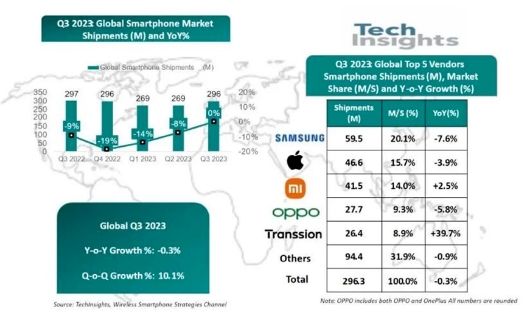
According to preliminary data from the International Data Corporation (IDC) Worldwide Quarterly Mobile Phone Tracker, smartphone vendors shipped a total of 355.2 million units during the third quarter of 2018 (3Q18), resulting in a year-over-year decline of 6.0%. This was the fourth consecutive quarter of year-over-year declines for the global smartphone market, which raises questions about the market's future. IDC maintains its view that the market will return to growth in 2019, but at this stage it is too early to tell what that growth will look like.While the overall smartphone market has declined for four straight quarters, two things stand out as major factors in the third quarter. Samsung, the largest smartphone vendor in terms of market share, accounting for 20.3% of shipments in 3Q18, declined 13.4% year over year in the quarter. And secondly, China, which is the largest country market for smartphone consumption, accounting for roughly one third of global shipments, was down as well for the sixth consecutive quarter.Samsung had a challenging quarter with shipments down 13.4% to 72.2 million units shipped. The market share leader continues to feel pressure from all directions, especially with Huawei inching closer to the top after its second consecutive quarter as the number two vendor. In addition, growing markets like India and Indonesia, where Samsung has held leading positions for many years, are being changed by the rapid growth of Chinese brands like Xiaomi, OPPO, and vivo.Meanwhile, China’s domestic market, which represents roughly one third of all smartphones consumed, has been in decline since the second quarter of 2017, and 3Q18 was the sixth consecutive quarter where the market sees contraction. China was down 11% in the first half of 2018 (1H18), and the challenges continued into 3Q18. Overall IDC expects this decline to decelerate with the market returning to flat growth in 2019."China's domestic market continues to be challenged as overall consumer spending around smartphones has been down," said Ryan Reith, program vice president with IDC's Worldwide Mobile Device Trackers. "High penetration levels, mixed with some challenging economic times, has slowed the world's largest smartphone market. Despite this, we believe this market will begin to recover in 2019 and beyond, driven in the short term by a large, built up refresh cycle across all segments, and in the outer years of the forecast supported by 5G migration.""The race at the top of the market continues to be a heated one as Huawei once again slipped past Apple to the second position," said Anthony Scarsella, research manager with IDC's Worldwide Quarterly Mobile Phone Tracker. "Although Huawei may have beat out Apple in Q3, the holiday quarter could have Apple as the market leader thanks to the launch of three new bezel-less devices. No matter who leads in the overall market the holiday quarter should be an exciting one with a wide selection of new flagship devices available. With the new iPhones, Mate 20, Pixel 3, V40, Note 9, and OnePlus 6T, we can expect consumers will have a plethora of options when upgrade time approaches. The vast selection of high-priced handsets should move ASPs in a positive direction come next quarter."Smartphone Company HighlightsSamsung had a very challenging quarter with smartphone shipments down 13.4% from 3Q17, with overall volumes of 72.2 million. While this was still enough to maintain the top market share position, the company does continue to lose share. The launch of the Galaxy Note 9 was successful and the device continues to build in shipments. However, Samsung's bigger challenge is the ground they are losing at the mid-range and low-end. Recent announcements of revamping the product portfolio to bring new features and awareness to non-flagship models could possibly help this slide. Samsung will most likely look to new A-Series devices to fill the gaps left in the mid-tier across numerous markets.Huawei landed in the number two position for the second straight quarter. While its share was down slightly from last quarter's 15.9%, overall the company should be pleased with shipping 52.0 million handsets and grabbing 14.6% of the overall market. From a product perspective, its P-series and recent update to its Mate-series are keeping it as competitive as ever at the top of the market. And its Honor brand, which is primarily marketed toward a younger audience and online sales, has continued to do well in many markets.Apple's newest iPhones helped push third quarter shipments to 46.9 million units, up 0.5% from the 46.7 million units last year. Apple once again launched three new devices at its Fall event, as the new 6.5-inch iPhone XS Max and 5.8-inch iPhone XS were joined by the more affordable iPhone XR in the Apple line-up. The new XS Max and XS continue off the success from last year's iPhone X but bring a new screen size option with more power and increased performance to the table. And Apple has once again improved the camera, upped the storage, and added a new faster processor via the A12 Bionic chip, which is the first 7-nanometer chip for Apple. Older iPhones, such as the 6S, 7, and 8, all received price cuts late in the quarter, which will balance the iPhone portfolio across all price tiers for the holiday quarter. The older SE and iPhone X from last year have been dropped from the Apple line-up. The fourth quarter will include shipments for the vastly popular iPhone XR, which have not been counted in IDC's Q3 figures.Xiaomi once again grew its share to a new company high capturing 9.7% of all smartphones shipped worldwide in 3Q18. Xiaomi continues its global expansion with market share gains in countries where it has been growing it presence, including India and Indonesia, and making headway into European markets like Spain where it continues to cause disruption. Its Redmi 5A, Redmi 5 Plus, and Redmi Note 5 have continued to do well, with the newer Redmi 6/A/Pro successors ramping up quickly.OPPO like Samsung saw shipments decline year over year, although on a much smaller scale. Despite that, OPPO remained the number 5 vendor in terms of market share with 29.9 million shipments in 3Q18, down 2.1% from a year ago. Like a few of its competitors that continue to climb the smartphone ladder, OPPO is beginning to gain global attention for some of its newer flagship devices that have come with highly marketed launch events. Designs on the Find X and R17 products are raising the bar for OPPO, and in return they are continuing to see their user ASPs increase. 
Key word:
Release time:2018-11-05 00:00 reading:1460 Continue reading>>
<span style='color:red'>Q3</span> Chip Sales Reach All-time High
Ericsson tops <span style='color:red'>Q3</span> forecasts as savings and 5G sales kick in
Mobile telecom equipment maker Ericsson beat third-quarter operating profit forecasts on Thursday, boosted by sales of next-generation 5G gear in North America, and said it was making solid progress towards its long-term financial goals.Marking its third consecutive quarter of substantial progress towards its 2020 financial targets, the company reported net sales rose 9 percent to 53.8 billion Swedish crowns ($6 billion) thanks to strong growth in its networks business.        That was led by early 5G sales in North America and 4G upgrades in Europe and Latin America, and helped to drive its shares 5 percent higher in early Thursday trading.However, finance chief Carl Mellander told Reuters that, as a result of this strong performance, fourth quarter sales growth would be "a few percentage points lower" than typical 17-18 percent growth versus the third quarter, adding North American network sales would be roughly flat quarter-on-quarter.Ericsson has pledged to deliver a gross margin of 37-39 percent by 2020. It nearly got there in the third quarter, reaching a figure of 36.9 percent, excluding restructuring charges, topping analysts' forecast of 36.2 percent.The quarterly operating margin rose to 6.0 percent from a negative 7.4 percent a year ago. Chief Executive Borje Ekholm said he was confident Ericsson could produce an operating margin of at least 12 percent beyond 2020."There is strong momentum in the global 5G market with lead markets moving forward," Chief Executive Borje Ekholm said in a statement. "More work remains, however, to get all parts of the business to a satisfactory performance level.Ericsson has responded to an industry-wide downturn and heavy losses since 4G network sales peaked in the middle of the decade with a strategy to focus on profitability over growth, replacing most of its management and making sweeping cost cuts.Operating profit for the latest quarter swung to 3.2 billion crowns ($356.5 million) from a 3.7 billion loss in the same period last year, outpacing a mean forecast for an 800 million crown profit in a Reuters poll of analysts.Shares in Ericsson have risen nearly 50 percent this year, buoyed by the progress towards its financial targets after three years of steep revenue declines.Ericsson now sits on the cusp of a potential new cycle of network upgrades as demand for 5G gear has started to kick in in the United States and is expected to be followed by upgrades in North Asian markets in early 2019.Net sales in North America, Ericsson's biggest regional market, rose 10 percent in currency-adjusted terms, while Europe rose 4 percent, offsetting weakness in its Middle East and North Asian markets.However, the company said it continued to invest heavily in 5G research and development, closely manage underperforming services businesses while keeping a tight rein on costs after completing a restructuring plan that will results in 5-7 billion crowns of restructuring charges this year.As a result, many investors want to see more proof of progress before betting on a sustained 5G recovery. Ten out of 15 analysts polled by Reuters rate the stock as "neutral" in terms of share price appreciation.Once the world's biggest supplier of mobile communications gear, Ericsson is facing falling spending by telecom operators, weakness in formerly fast-growing emerging markets and stiff competition from bigger rivals Huawei of China and Nokia of Finland.
Key word:
Release time:2018-10-19 00:00 reading:3377 Continue reading>>
Samsung Display’s AMOLED Fab Utilization to Recover to Above 80% in <span style='color:red'>Q3</span> 2018
According to IHS, Samsung Display’s average AMOLED fab utilization rate started to plunge from the end of 2017. It remained in the 50% range until May, due to low seasonality and weaker-than-expected demand from major customers.In H1 2018, glass input at the A3 fab fell significantly short of the capacity that nearly doubled in H2 2017. Contrary to expectations that the fab would enjoy a surge in flexible AMOLED panel demand following the launch of new smartphones from Samsung Display’s key customers, especially from Apple, it grappled with lower-than-expected demand. In H1 2018, utilization remained low in both A1 and A2 fabs due to growing competition from LTPS LCD panels in the smartphone display market and disappointing demand from Chinese customers.However, the average monthly utilization rate at Samsung Display’s AMOLED fabs is expected to increase significantly to above 80% in Q3 2018. The A3 fab, which accounts for the lion’s share of Samsung Display’s AMOLED panel production, will see its utilization jump due to the upcoming launches of Samsung Electronics’ and Apple’s new smartphones and a recovery in seasonal demand. With increasing demand from Chinese customers, utilization at A1 and A2 also started to soar from June.In Q3 2018, total glass input area at Samsung Display’s AMOLED panel fabs will top the previous record high. It reached nearly 600,000 m² in Q4 2017 but plummeted to 333,000 m² in February 2018. In Q3 2018, it is forecast to nearly double from the February low.In H1 2019, demand for Samsung Display’s AMOLED panels is expected to decline from that in the end of 2018, driven by the typical slowdown in panel demand for new smartphones and the year-end shopping season. However, utilization rates will not likely fall to the H1 2018 level due to the growing adoption of AMOLED by its customers, the launch of foldable panels, and increasing demand for curved products.However, it is uncertain whether the jump in overall utilization rates will bring forward the mass production start date of the A4 fab, which has been delayed due to low utilization at other existing fabs; rather, it depends more on whether Samsung Display will succeed in adding more customers and expanding the AMOLED business into new applications, the key to the sustainable growth of its AMOLED business.
Key word:
Release time:2018-09-10 00:00 reading:1444 Continue reading>>
Semiconductor Sales Hit $108 Billion in <span style='color:red'>Q3</span>
  Global semiconductor sales topped $100 million in a quarter for the first time in the third quarter, reaching $107.9 billion, according to the Semiconductor Industry Association (SIA) trade group.  Third quarter sales were up more than 10 percent from the second quarter, which set the previous high-water mark for chip sales in a quarter with $97.9 billion, according to the SIA, which reports sales figures compiled by the World Semiconductor Trade Statistics organization, a group made up of more than 55 leading chip makers worldwide.  Year-to-date, semiconductor sales are tracking more than 20 percent ahead of last year's pace. The semiconductor industry is almost certain to set a sales record this year, with sales potentially topping $400 billion for the first time, thanks largely to tremendous growth in memory revenue amid tight supply.  The three-month moving average of semiconductor sales in September also set a new record for the industry. Sales grew to $36 billion, up 2 percent compared with August and up 22 percent compared with September 2016, the SIA said.  September sales increased across all markets compared to August and compared to September 2016, according to the SIA. Sales in the Americas region grew by nearly 6 percent sequentially and by nearly 41 percent compared to last year, according to the SIA. Sales in both China and Europe also grew by 19 percent year-over-year, according to the trade group.  "The Americas market continued to stand out, notching its largest year-to-year sales increase in more than seven years," said John Neuffer, SIA president, in a press statement. "Standouts among semiconductor product categories included memory products like DRAM and NAND flash, both of which posted major year-to-year growth in September, as well as logic products, which enjoyed double-digit growth year-to-year."  In its most recent forecast, published in August, the WSTS projected that chip sales would increase by 17 percent this year to reach $397 billion. Other market watchers are even more bullish; market research firm IC Insights recently predicted that semiconductor sales would increase by 22 percent this year, largely driven by surging DRAM and NAND sales. The firm said the overall memory segment is expected to grow sales by 58 percent this year, according 44 percent growth in NAND sales and a whopping 72 percent growth in DRAM sales.
Key word:
Release time:2017-11-01 00:00 reading:1670 Continue reading>>

Turn to

/ 2

  • Week of hot material
  • Material in short supply seckilling
model brand Quote
CDZVT2R20B ROHM Semiconductor
BD71847AMWV-E2 ROHM Semiconductor
TL431ACLPR Texas Instruments
RB751G-40T2R ROHM Semiconductor
MC33074DR2G onsemi
model brand To snap up
BP3621 ROHM Semiconductor
STM32F429IGT6 STMicroelectronics
ESR03EZPJ151 ROHM Semiconductor
TPS63050YFFR Texas Instruments
BU33JA2MNVX-CTL ROHM Semiconductor
IPZ40N04S5L4R8ATMA1 Infineon Technologies
Hot labels
ROHM
IC
Averlogic
Intel
Samsung
IoT
AI
Sensor
Chip
About us

Qr code of ameya360 official account

Identify TWO-DIMENSIONAL code, you can pay attention to

AMEYA360 mall (www.ameya360.com) was launched in 2011. Now there are more than 3,500 high-quality suppliers, including 6 million product model data, and more than 1 million component stocks for purchase. Products cover MCU+ memory + power chip +IGBT+MOS tube + op amp + RF Bluetooth + sensor + resistor capacitance inductor + connector and other fields. main business of platform covers spot sales of electronic components, BOM distribution and product supporting materials, providing one-stop purchasing and sales services for our customers.

Please enter the verification code in the image below:

verification code