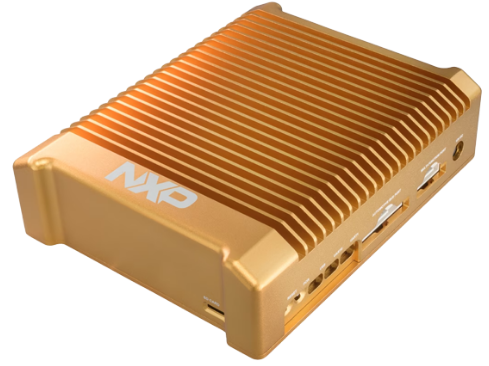
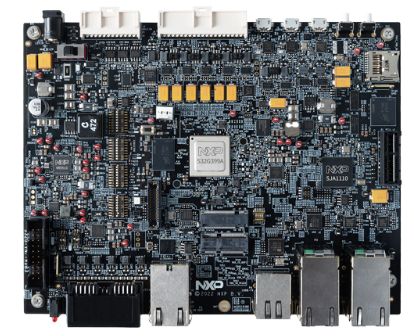


Ameya360:NXP Semiconductors GoldBox 3 Vehicle <span style='color:red'>Networking</span> Development Platform
  NXP Semiconductors GoldBox 3 Vehicle Networking Development Platform is designed for vehicle Service-Oriented Gateways (SoGs), domain control applications, high-performance processing, and safety and security applications. This development platform offers high-performance computing capacity, real-time network performance, multi-Gigabit packet acceleration, security, and rich input/output (I/O).  These target the central gateway, domain controller, FOTA, secure key management, smart antenna, and high-performance central compute nodes. The GoldBox 3 vehicle networking development platform supports low-power mode, multiple wake-up sources, and two M.2 modules. Typical applications include Firmware Over-the-Air (FOTA), automotive access points, safety processors, service-oriented gateway, vehicle compute, and zonal gateways.  FEATURES  Hardware:  Supports service-oriented gateway and domain controller applications  Multiple network interfaces featuring 18 CAN/CAN FD and 12 Ethernet ports  Supports low-power mode and multiple wake-up sources  Supports two M.2 modules (M-key slot and E-key slot)  12V AC-DC adapter power supply  Interfaces:  LIN, CAN/CAN FD, 100BASE-T1, 1000BASE-T / 2.5GBASE-T, 100BASE-TX, 1000BASE-T, FlexRay, USB, PCIe, JTAG, UART, AURORA, and M.2 slots  Safety:  ISO 26262 support by using safety components and architecture  KIT CONTENTS  Rugged enclosure with integrated thermal management  S32G reference design board 3  Universal AC adapter  AC/DC 12V 6.67A power supply  32GB SD card  DuPont line  2x USB A-to-micro B cables (UART0/1)  CAT6A Ethernet cable  Ethernet loopback cable  3x Heatsinks  FAN solution for S32G  Screws (M.2 slots)  1.27mm mini jumpers and cables  APPLICATIONS  Automotive access point  Automotive data logger  Automotive zone controller  Domain controllers  Firmware Over-the-Air (FOTA)  Gateway  In-vehicle networks  Safety processors  Service-oriented gateway  Vehicle compute  Zonal gateways
Key word:
Release time:2023-03-24 13:44 reading:2087 Continue reading>>
AMEYA360:NXP Semiconductors S32G3 Vehicle <span style='color:red'>Networking</span> Reference Design
  NXP Semiconductors S32G3 Vehicle Networking Reference Design is designed for vehicle Service-Oriented Gateways (SoGs), domain control applications, high-performance processing, and safety and security applications. This reference design is based on the octal Arm Cortex-A53 cores and quad, dual-core lockstep Arm Cortex-M7 cores.       The S32G3 vehicle networking reference design offers high-performance, real-time network performance, multi-gigabit packet acceleration and security, and rich input/output (I/O). Typical applications include Firmware Over-the-Air (FOTA), automotive access points, safety processors, service-oriented gateway, vehicle compute, and zonal gateways.  FEATURES  Hardware:  Supports service-oriented gateway and domain controller applications  Multiple network interfaces, featuring 18 CAN/CAN FD and 12 Ethernet ports  Supports low-power mode and multiple wake-up sources  Supports two M.2 modules (M-key slot, E-key slot)  ISO 26262 support by using safety components and architecture  12V AC-DC adapter  Interfaces:  LIN, CAN/CAN FD, 100BASE-T1, 1000BASE-T / 2.5GBASE-T, 100BASE-TX, 1000BASE-T, FlexRay, USB, PCIe, JTAG, UART, AURORA, and M.2 slots  KIT CONTENTS  S32G Reference Design Board 3  Universal AC adapter  AC/DC 12V 6.67A power supply  32GB SD card  DuPont line  2x USB A-to-micro B cables (UART0/1)  CAT6A Ethernet cable  Ethernet loopback cable  3x Heatsinks  FAN solution for S32G  Screws (M.2 slots)  1.27mm mini jumpers and cables  APPLICATIONS  Automotive access point  Automotive data logger  Automotive zone controller  Domain controllers  Firmware Over-the-Air (FOTA)  Gateway  In-vehicle networks  Safety processors  Service-oriented gateway  Vehicle compute  Zonal gateways
Key word:
Release time:2023-03-24 13:41 reading:2420 Continue reading>>
AMEYA360:<span style='color:red'>Networking</span> a Smart City: Using Fit-for-Purpose Tech
  Multiple market forecasts project smart cities will grow at a compounded annual growth rate of as much as 25% between now and 2030, making cities a very attractive market for internet of things (IoT) solution providers. However, cities present various unique challenges for vendors seeking to enter this market.  Cities are highly complex deployments for any technology, and IoT networking is no exception. Let’s examine the challenges to understand why selecting a networking technology designed to meet a city’s needs is vital.  Diagram of a smart city, where LoRaWAN is essential for networking.  First, there are very real physical challenges to deploying networks in cities. Cities are largely built with steel and concrete, which creates connectivity issues as wireless signals often struggle to penetrate these materials. Further, many IoT sensors reside in basements or underground, which also presents a challenge for achieving reliable connections. So, it is important to select a networking technology with a track record of success in urban environments, like LoRaWAN (LoRa stands for Long Range).  LoRaWAN is proven to transmit signals through cement, metal and underground. The recent addition of battery-operated relays provides an easy-to-deploy, low-power and standards-based approach to extend LoRaWAN coverage beyond its current physical limits at a fraction of the cost of adding additional gateways.  Second, the vast majority of IoT applications transmit tiny amounts of data, making low-bandwidth networking desirable because it meets the connectivity and scaling requirements at a fraction of the cost of high-bandwidth technologies. With LoRaWAN, a single gateway supports thousands of sensors and costs only hundreds of dollars, making it highly cost effective to expand the system as new applications are added to the network. This scalability is a critical benefit for cities that want to be sure their networking choice will continue to be optimal even with future urban development and growth.  Third, it is crucial to consider the power consumption of the devices. Maintenance and ongoing operation are key drivers of cost that must be considered when making a networking decision. Using end devices with low-power consumption extends battery life to more than 10 years, saving time, money and our environment.  It is important to note that there will be millions of devices operating in hard-to-reach places, or buried underground, so longer battery life also saves significant time and labor costs. This allows LoRaWAN to deliver considerable cost savings over a device’s lifetime, which increases environmental and energy sustainability in turn.  Fourth, having flexible business models future proofs a networking solution because a city’s needs will evolve over time. LoRaWAN addresses this by offering the most network flexibility of any LPWAN, allowing it to meet the needs of all departments, which each have their own unique requirements. A city can build a private network, subscribe to a public or satellite one, join a community network, or utilize a hybrid. Finally, a city also has the ability to roam across these various types of deployment options.  Fifth, because cities are governmental entities, there are many rules, regulations and requirements to consider. Open standards are the only viable choice when investing in long-term solutions because they enable longevity and are backed by dynamic ecosystems that foster competition and give cities a choice in terms of vendors and pricing. Proprietary solutions are problematic because they lock cities into a single vendor, which restricts the quantity and types of available products and may include price lock-ins.  These are serious drawbacks that risk not meeting all a city’s long-term needs. Further, cities should insist on using end devices that are certified by a regulatory body. Certification is the only way to have confidence that devices will be reliable and compliant with the standards, thus reducing potential support costs and ensuring interoperability. LoRaWAN meets these requirements, having been officially approved as a standard by the International Telecommunications Union (ITU). Additionally, the technology is backed by the LoRa Alliance Certification Program.  Because cities that want to become smart must anticipate future needs and consider current challenges, open standards like LoRaWAN are ideal because they bring reliability, flexibility and ecosystems that offer a wide variety of choices. These features allow cities to find strong partners who are willing to innovate and collaborate to solve the city’s challenges. Combine the use of open standards with a requirement to deploy certified end devices, and cities’ IoT connectivity selections will offer a return on investment for years to come.
Key word:
Release time:2023-03-15 11:18 reading:1722 Continue reading>>
Four Providers of Datacenter Software-Defined <span style='color:red'>Networking</span> Named IDC Innovators
  International Data Corporation (IDC) today published an IDC Innovators report focusing on four technology providers that are considered key emerging vendors in the software-defined networking (SDN) market. The four companies named as IDC Innovators are Apstra, Inc., Big Switch Networks, Inc., Plexxi, and Pluribus Networks.  SDN, and its evolutionary extension into intent-based networking (IBN), represents an architectural approach to datacenter networking in the cloud era. It is defined by an abstracted architectural model that better aligns network infrastructure with the needs of application workloads through automated (thereby faster) provisioning, programmatic network management, pervasive application-oriented visibility and, where needed, direct integration with cloud orchestration platforms. These capabilities can translate into significant operational savings while providing organizations with the means of faster time to business outcomes and revenue realization.  "Given the imperative of digital transformation and the need to support cloud-native applications and to deliver cloud-like agility, enterprises are compelled to modernize their datacenter-network architectures and operational models. Fortunately, practical and viable options for datacenter SDN and IBN are available, addressing requirements associated with a broad range of workloads and use cases. This IDC Innovators report profiles four vendors that take varied approaches to addressing the need for datacenter networking in the cloud era," said Brad Casemore, research vice president, Datacenter Networks.  Apstra offers a vendor-agnostic datacenter-network operating system and intent-based analytics that provide real-time, continuous closed-loop validation. Big Switch Networks offers a fabric-based SDN solution that is designed to make the datacenter network intelligent, agile, and flexible. Plexxi offers a programmable, workload-driven Ethernet/IP-based datacenter fabric that enables convergence of discrete networks into an intelligent datacenter fabric serving all workloads. Pluribus Networks offers a dynamic, scale-out architecture that enables organizations to build a next-generation private or public cloud that is optimized to support mission-critical environments.
Key word:
Release time:2018-03-29 00:00 reading:1361 Continue reading>>

Turn to

/ 1

  • Week of hot material
  • Material in short supply seckilling
model brand Quote
BD71847AMWV-E2 ROHM Semiconductor
CDZVT2R20B ROHM Semiconductor
TL431ACLPR Texas Instruments
MC33074DR2G onsemi
RB751G-40T2R ROHM Semiconductor
model brand To snap up
IPZ40N04S5L4R8ATMA1 Infineon Technologies
TPS63050YFFR Texas Instruments
ESR03EZPJ151 ROHM Semiconductor
STM32F429IGT6 STMicroelectronics
BU33JA2MNVX-CTL ROHM Semiconductor
BP3621 ROHM Semiconductor
Hot labels
ROHM
IC
Averlogic
Intel
Samsung
IoT
AI
Sensor
Chip

About us

Qr code of ameya360 official account

Identify TWO-DIMENSIONAL code, you can pay attention to

AMEYA360 mall (www.ameya360.com) was launched in 2011. Now there are more than 3,500 high-quality suppliers, including 6 million product model data, and more than 1 million component stocks for purchase. Products cover MCU+ memory + power chip +IGBT+MOS tube + op amp + RF Bluetooth + sensor + resistor capacitance inductor + connector and other fields. main business of platform covers spot sales of electronic components, BOM distribution and product supporting materials, providing one-stop purchasing and sales services for our customers.

Please enter the verification code in the image below:

verification code