NOVOSENSE shares insights into automotive ultrasonic sensing at 2026 APEC 44th Automotive Dialogue
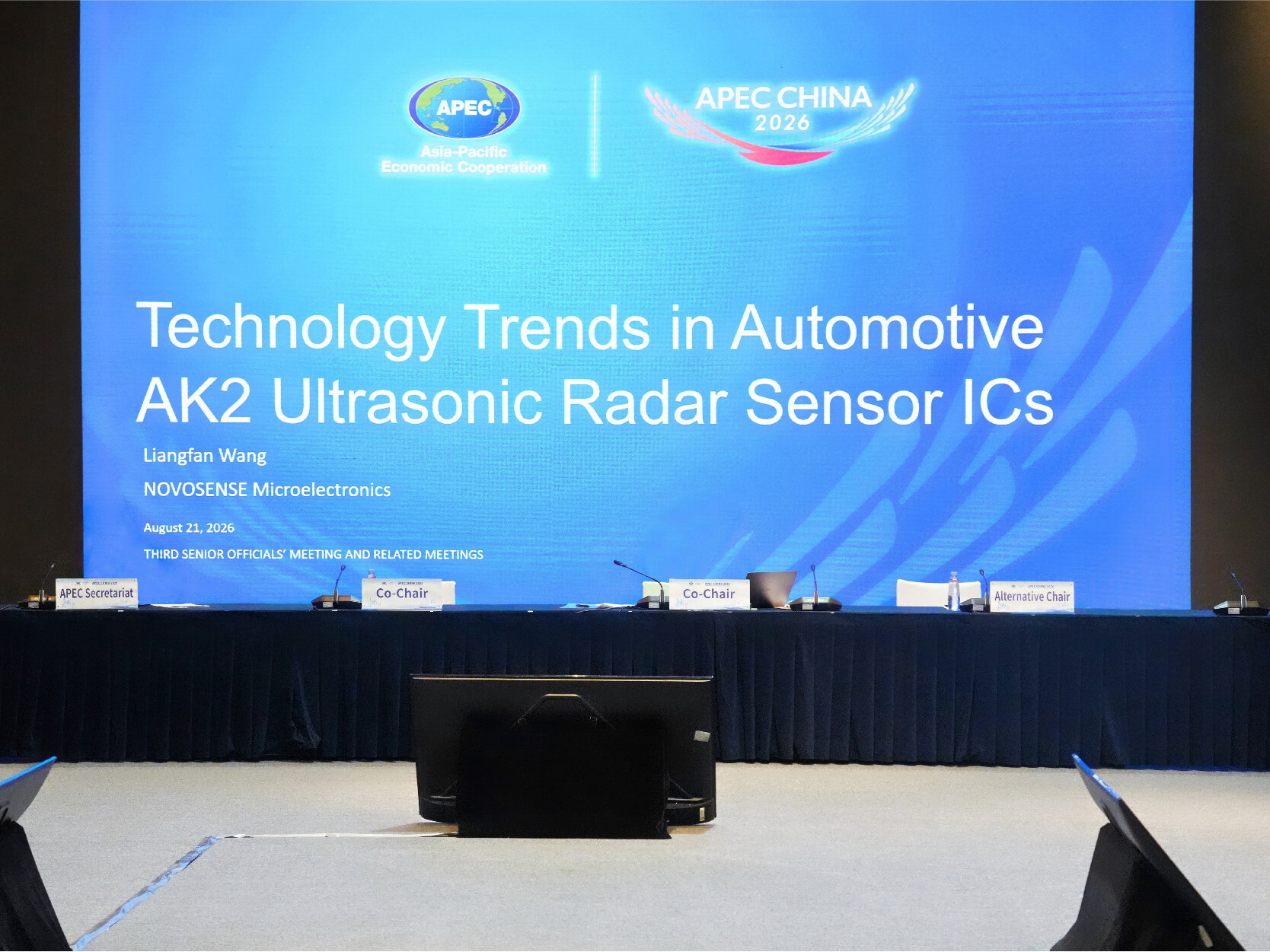
NOVOSENSE shared its latest insights into automotive AK2 ultrasonic radar sensor ICs at the 44th Automotive Dialogue of the Asia-Pacific Economic Cooperation, or APEC, held in Dalian, Liaoning province, China, from Aug 19 to 21.
The meeting brought together representatives from government departments, industry associations and companies across APEC economies. Discussions focused on automotive market, policy and industry trends in the Asia-Pacific region, resilient and transparent automotive supply chains, the development of the hydrogen vehicle industry, and opportunities and challenges in advanced vehicle technologies.
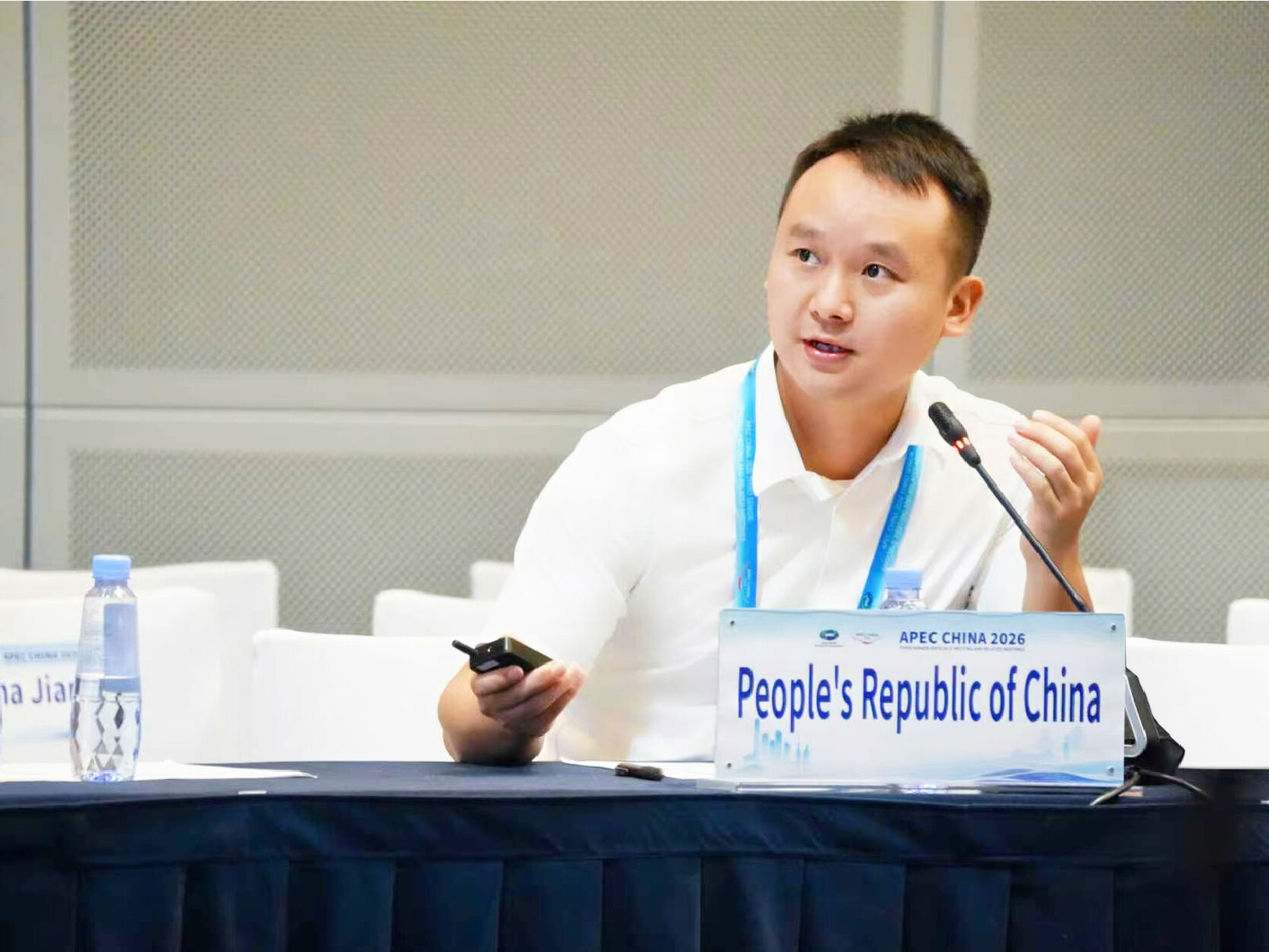
Liangfan Wang, technical marketing lead for the signal chain product line at NOVOSENSE, delivered a presentation on technology trends and practical solutions for AK2 ultrasonic radar sensor ICs, exchanging ideas with participants on the challenges and opportunities in automotive intelligent sensing.

Shift toward digital architectures
Automotive ultrasonic radar is moving from analog to digital architectures. Compared with the conventional AK1 analog architecture, AK2 uses digitally encoded modulation and echo signal processing to improve detection range, measurement accuracy and resistance to interference.
Its interface has also evolved from point-to-point connections to a shared bus that supports coordinated operation among multiple sensors. AK2 ultrasonic radar has been applied in ultrasonic parking assist, automatic parking assist and automated valet parking systems.
Development of multidimensional sensing
Automotive ultrasonic sensing is expanding from 1D and 2D ranging toward 3D and 4D sensing. Its applications are also extending to low-speed automatic emergency braking, obstacle-type detection, road-surface classification and minor-impact detection.
The technology continues to provide advantages in short-range sensing while working alongside millimeter-wave radar, ultra-wideband technology and cameras.
Bumper-level sensing cycles are being reduced to less than 100 milliseconds, allowing vehicles to detect obstacles earlier and improving the efficiency of automated valet parking. This requires sensor ICs to provide stronger coordination among multiple transmit and receive channels, as well as greater resistance to interference.
Further improvements are also required for object classification, road-surface recognition, sensor contamination detection and near-field blind-zone reduction. These functions require access to raw sensing data at different stages of signal processing.
At the system level, MCU-less designs, two-wire DSI3 connectivity and direct-drive architectures can help reduce component and wiring-harness costs. The DSI3 architecture carries power and communication over the same pair of wires, while the direct-drive architecture removes the need for an external transformer.
Flexible encoding reduces sensing time
NOVOSENSE uses an arbitrary frequency pattern generator to provide fixed-frequency transmission, linear and nonlinear frequency encoding, and combined frequency-shift keying and chirp encoding.
The solution supports multiple transmit and receive operation to improve resistance to interference. A bumper scan can be completed within two scanning cycles.
Raw-data access extends the sensing range
NOVOSENSE provides a configurable data-upload path with selectable decimation ratios ranging from 1× to 16×. Data can be compressed by the MCU before being uploaded through the DSI3 interface.
Available data includes ADC raw data within a 2-millisecond window, post-mixing in-phase and quadrature data, and envelope data captured before and after an event.
A time-varying low-noise amplifier automatically switches gain to reduce near-field saturation. The solution covers detection distances ranging from about 10 centimeters to 6.5 meters.
DSI3 supports cross-brand interoperability
NOVOSENSE has developed a cross-brand interoperability architecture based on the standard DSI3 protocol. It supports combinations of NOVOSENSE devices and other industry-standard DSI3 devices, as well as point-to-point, parallel and daisy-chain configurations.
The NSUC1800 supports vendor-defined Command and Response Mode commands, while the NSUC1802 provides a DSI3 buffer of 2 kilobytes per channel. The two products address different requirements for functional expansion and flexible data access.
About the APEC Automotive Dialogue
Established in 1998, the APEC Automotive Dialogue provides a regular communication platform for government authorities and automotive industry representatives from APEC economies. It promotes exchanges and cooperation in areas including development strategies, standards and regulations, and technological innovation.

在线留言询价


Visit NOVOSENSE at PCIM Europe 2026!


- 一周热料
- 紧缺物料秒杀
| 型号 | 品牌 | 询价 |
|---|---|---|
| RB751G-40T2R | ROHM Semiconductor | |
| CDZVT2R20B | ROHM Semiconductor | |
| TL431ACLPR | Texas Instruments | |
| MC33074DR2G | onsemi | |
| BD71847AMWV-E2 | ROHM Semiconductor |
| 型号 | 品牌 | 抢购 |
|---|---|---|
| BP3621 | ROHM Semiconductor | |
| BU33JA2MNVX-CTL | ROHM Semiconductor | |
| STM32F429IGT6 | STMicroelectronics | |
| TPS63050YFFR | Texas Instruments | |
| ESR03EZPJ151 | ROHM Semiconductor | |
| IPZ40N04S5L4R8ATMA1 | Infineon Technologies |

























AMEYA360公众号二维码
识别二维码,即可关注


请输入下方图片中的验证码: