
Ameya360:Li-ion Battery Material Prices Drop in January Amid Slowing Growth in Chinese NEV Market
  There was an across-the-board decline in prices of upstream (raw) materials for lithium ion (Li-ion) batteries in January as participants in the industry chain in China were focusing on inventory consumption, according to TrendForce. The decline was especially significant for upstream materials related to cathodes, cathode materials, and battery electrolytes.  The average price of lithium carbonate, which is the most costly among the upstream materials related to cathodes, fell by 12% month-on-month (MoM). Lithium hydroxide also suffered a price drop, but the demand for this material was bolstered by orders from regions outside China. Compared with lithium carbonate, lithium hydroxide experienced a more moderate price slide. Nevertheless, the average prices of battery-grade lithium carbonate and lithium hydroxide both dipped below Rmb500,000 per metric tons. Turning to electrolytes and related upstream materials, the average price of LiPF6 (lithium hexafluorophosphate) fell by 11% MoM for January. This, in turn, caused the average price of electrolytes to drop by 11~15% MoM for the same month.  TrendForce points out that China initiated the phase-out of its NEV (new energy vehicle) subsidy at the start of 2023. Other regions of the country have introduced other subsidy policies in the hope of stimulating consumption, and the preferential rate for the purchase tax on NEV purchase has been extended to the end of 2023.  However, a significant portion of Chinese consumers’ demand for new vehicles was expended in 4Q 2022 when the country saw energetic promotional activities that aimed to spur NEV sales. Moving into this first quarter, the Chinese car market has been affected by the low season. On the whole, NEV sales in China has slowed down recently and thereby caused a general decline in prices of upstream materials for Li-ion batteries. On the other hand, the drop in material prices has reduced some of the cost pressure on the manufacturing of Li-ion batteries.  Regarding price trends of NEV power battery products in China, prices of battery cells on the whole fell by about 1% MoM for January. Various cell types including ternary cells and prismatic LFP (lithium iron phosphate) cells experienced a MoM decline of 1~2%. TrendForce projects that their prices will go down further in February.  In the market for energy storage battery cells, most products are LFP cells, and their prices fell by 2% MoM for January to reach the average of Rmb0.94 per watt-hour. Also, due to the policy support that the Chinese government has been providing for the development of energy storage technologies, the demand for Li-ion energy storage batteries is expected to rebound slightly going forward. Prices of energy storage battery cells are currently projected to remain mostly flat or drop a bit for 1Q23.  Lastly, looking at Li-ion battery cells for consumer electronics, the average price of LCO (lithium cobalt oxide) cells in China came to around Rmb9.9 per amp-hour in January. Transactions were low in the market for consumer batteries due to the slumping demand for electronic devices. Furthermore, prices of the upstream materials for LCO cathodes kept sliding.  Looking ahead, the market for LCO materials is expected to remain weak in the short term, it will witness a further price decline in February.
Key word:
Release time:2023-02-17 13:58 reading:2091 Continue reading>>
Demand for xEV Batteries Grow Steadily, but Chinese xEV Battery Market Faces Reshuffle as Subsidies Phase Out
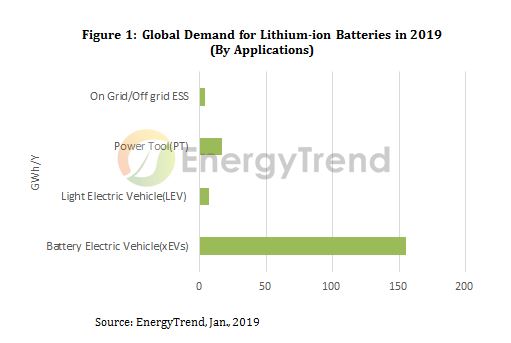
  According to the latest research by EnergyTrend, a division of TrendForce, the market of new energy vehicle will continue to grow steadily, driving the demand for xEV batteries, despite the slowdown in global automotive market since 2018. The global demand for lithium-ion batteries used in new energy passenger cars is estimated to reach 155GWh in 2019, a growth of 63% from 95GWh in 2018.  According to Duff Lu, senior research manager of EnergyTrend, China has become the world's fastest-growing market for new energy vehicles driven by the government’s subsidies and supporting policies. After a rapid growth in 1H18, the shipments of new energy cars in China slowed down in 2H18, moderating the demand in the xEV battery industry as well. However, with increasing penetration of new energy vehicles, the demand for lithium-ion batteries used in new energy passenger cars in China will grow to 54GWh in 2019, a growth of nearly 80% from 30GWh in 2018.  In terms of supply, the production capacity of xEV battery in China has surpassed 134GWh by the end of 2018, and has a chance to reach 164GWh in 2019. Amid the oversupply and phasing out of subsidies from the Chinese government, the industry has been faced with a reshuffle since the second half of 2018. Major manufacturers have grown stronger at the expense of the demise of smaller companies. Leading players like Contemporary Amperex Technology (CATL) and BYD continue to expand, while less competitive ones who rely too much on regional markets, such as OptimumNano Energy, may have to exit the market during the market reshuffle.  EnergyTrend expects that, with new capacity entering operation in 2019, the xEV battery industry will become more concentrated. The top five battery manufacturers would continue to grow and become the major suppliers. Subsidies from the Chinese government will be phased out by 2020, but before that, the industry will still depend on the subsidies to cover their R&D costs for advanced battery technologies. Manufacturers need to continue the development of high energy density solutions, building up competitiveness, before the electric vehicle market enters the maturity stage.
Key word:
Release time:2019-01-25 00:00 reading:5137 Continue reading>>
SK Innovation Announces New Battery Manufacturing Plant in Georgia, United States
SK Innovation announced it will create more than 2,000 jobs and invest $1.67 billion to build a new electric vehicle (EV) battery manufacturing plant in Georgia.SK Innovation, which is part of SK Group, is making the investment to better compete in the growing global EV battery market. Customers for SK Innovation include Mercedes-Benz and Hyundai-Kia Motors, and this new investment will provide opportunities for SK Innovation to bring its world-class products to additional automakers in the United States.“We are excited to bolster our presence in the United States by making this investment in Georgia,” said Jun Kim, CEO of SK Innovation. “SK Innovation is a worldwide leader in the energy industry and this latest investment will allow us to work with the growing automotive industry in the Southeastern United States, ensuring future partnerships for years to come.”The new plant will be located in Jackson County, Georgia. Construction will occur in two phases, beginning in early 2019. The first phase will invest approximately $1 billion and employ more than 1,000 advanced manufacturing employees, making it the largest scale electric vehicle battery plant in the United States. SK Innovation leadership worked closely with federal, state and local officials to finalize the investment.“SK Group’s investment in the state of Georgia is undeniable proof that President Trump’s economic policies are working for the American economy and American worker,” said U.S. Secretary of Commerce Wilbur Ross.“I am delighted that a world-class technology company such as SK sees the merits of manufacturing in the United States. As similar companies across the world are discovering, there is no better place to do business than right here in America.”
Key word:
Release time:2018-12-05 00:00 reading:1762 Continue reading>>
Global Electric Vehicle Market Continues to Expand as Power Battery Prices Decrease
The global electric vehicle market continues to expand while the oil prices increase, power battery prices decrease, and countries have been proposing stricter CO2 emission targets for vehicles. EnergyTrend, a division of TrendForce, forecasts that the market share of electric vehicles will reach 5% in 2020 and 8~9% in 2023.According to Duff Lu, senior research manager of EnergyTrend, stricter CO2 emission targets for vehicles worldwide have been the main momentum for the growth of electric vehicle market. The target of CO2 emissions for cars in China was 200g/km in 2015, and is expected to be 119g/km in 2020. In North America and Europe, the targets will be 124g/km and 95g/km respectively in 2020, down from 150g/km and 130g/km respectively in 2015. By 2020, it will the first time for China to have a CO2 emission target lower than the U.S.Generally speaking, Europe is reducing the CO2 emission step by step with great emphasis on environment protection. China is promoting electric vehicles using lithium-ion battery to integrate its domestic battery industry, which is a unique advantage. The United States is also striving to reduce carbon emission, but American car makers tend to be more conservative about this new energy, while drivers prefer to buy large cars.On the battery side, the price of cobalt has been high in the past quarters, but the price of power batteries is expected to decrease steadily in the future with technical breakthroughs to be made. Solutions for high voltage and solutions with high ratio of nickel are expected decrease the use of cobalt. The price of lithium-ion batteries for vehicles was about 400~600 USD/kWh in 2016, and has decreased to 250~300 USD/kWh in 2018. The price is expected to fall below 200 USD/kWh in 2019.Currently, electric vehicles are designed for short- or mid-range ride of 200~400km due to the energy density of lithium-ion battery, while fuel cells are used for mid- to long-range ride of 400~600km. As for the future, with the decreasing costs and increasing capacity of lithium-ion batteries, electric vehicles may also be used for mid- to long-range ride, squeezing the market share of fuel cells.Previously, Toyota released high-energy-density fuel cells, whose prices have been decreasing rapidly in recent years. However, the current lifespan of the battery system is only 3,000 hours, thus peripheral devices are required to increase the lifespan. The additional costs would also impede mass production of vehicles using fuel cells. According to the survey of EnergyTrend, the average price of lithium-ion batteries in each electric passenger car is currently about US$15,000, and is expected to fall below US$10,000 in 2020, while the cost of fuel cells is about US$20,000 currently, showing a large gap.New tariffs may influence Chinese automobile industry and promote local assembly of carsAs the tariffs on Chinese exports to the US took effect last week, the Chinese automobile industry has been affected. 28 items are included in the tariff list, covering entire vehicles and components. This will also increase the tariff on imported cars in China to 40%. Currently, only about 5% of the cars in the Chinese auto market are imported, 20% of which come from the United States. The major brands include Tesla, Lincoln, Mercedes-Benz and BMW, who have been adjusting their prices since China reduced its import tariff on autos in May 2018. However, the trade war has brought the tariff back to the original level. Meanwhile, China have eased some of the previous restrictions on foreign investment and released new regulation of credit score for new energy cars, which would jointly motivate Chinese car makers to seek cooperation with foreign companies. As for the new energy vehicles, EnergyTrend believes that the increased tariffs on imported vehicles in China will promote the local assembly of cars, but would not necessarily promote the local production of components.
Key word:
Release time:2018-07-10 00:00 reading:1464 Continue reading>>
True lithium-air <span style='color:red'>battery</span> produced
  A lithium-air battery that works in a natural-air environment, while still being able to function after a record-breaking 750 charge/discharge cycles has been designed by a team from the University of Illinois at Chicago and at Argonne National Laboratory.  The batteries would work by combining lithium, present in the anode, with oxygen from the air to produce lithium peroxide on the cathode during the discharge phase. The lithium peroxide would be broken back down into its lithium and oxygen components during the charge phase.  Experimental designs of lithium-air batteries have previously been unable to operate in a true natural-air environment due to the oxidation of the lithium anode and production of undesirable byproducts on the cathode that result from lithium ions combining with carbon dioxide and water vapor in the air. These byproducts gum up the cathode, which eventually becomes completely coated and unable to function. These experimental batteries have relied on tanks of pure oxygen, which limit their practicality and pose safety risks.  The research team said it overcame this by using anode, cathode and electrolyte to prevent anode oxidation and buildup of battery-killing byproducts on the cathode.  It coated the lithium anode with a thin layer of lithium carbonate that selectively allows lithium ions from the anode to enter the electrolyte, while preventing unwanted compounds from reaching the anode.  In a lithium-air battery, the cathode is where the air enters the battery. In experimental designs of lithium-air batteries, oxygen, and the other gases that make up air, enters the electrolyte through a carbon-based spongy lattice structure.  The researchers coated the lattice structure with a molybdenum disulfate catalyst and used a hybrid electrolyte made of ionic liquid and dimethyl sulfoxide to facilitate lithium-oxygen reactions, minimise lithium reactions with other elements in the air and boost battery efficiency.
Release time:2018-03-23 00:00 reading:1329 Continue reading>>
Uncovering the iPhone Battery Slowdown
  A battery problem with Apple iPhones has spawned eight lawsuits seeking class-action status against the handset maker, according to a Reuters report. The founder of a popular benchmark program shared his experience being among the first to identify the issue.  The lawsuits generally claim Apple failed to inform users about known performance issues that could be solved with a battery replacement, rather than buying a next-generation handset. For the past year, upgrades of iOS have intentionally slowed processors to avoid unintended shutdowns when chips demanded power spikes an aging battery could no longer deliver.  The problem came to light earlier this year for John Poole, founder of Primate Labs, the developer of Geekbench. He saw a spike in complaints about slowing performance from iPhone users coupled with 40 percent declines in Geekbench numbers.  “Whenever a new version of the iPhone comes out, we get complaints about older iPhones that feel slow. Apple does more with new OSes, and older phone can’t necessarily keep up…it’s not nefarious, and we are used to a certain level of these complaints…[but] this year we saw more of those complaints coupled with decreases in Geekbench,” Poole said in an interview.  When a user posted on Reddit that his iPhone’s performance returned to normal after he replaced its battery, “I started digging into the results and that’s when I realized there was something going on,” Poole said.  He tapped into his database of 6 million Geekbench scores, plotting performance of different versions of the iPhone using different versions of iOS. Handsets using iOS version 10.2.1 and later revealed an anomaly. Rather than a single distribution around an average peak performance, they also showed the highest peak followed by multiple lower peaks.  “The conclusion we drew was 10.2.1 introduced some change that effected performance in a systematic way in a significant number of phones,” Poole said.  After he published his results, Apple publicly responded to growing questions with a statement posted by National Public Radio and other a Web sites:  “Lithium-ion batteries become less capable of supplying peak current demands when in cold conditions, have a low battery charge or as they age over time, which can result in the device unexpectedly shutting down to protect its electronic components.  "Last year we released a feature for iPhone 6, iPhone 6s and iPhone SE to smooth out the instantaneous peaks only when needed to prevent the device from unexpectedly shutting down during these conditions. We've now extended that feature to iPhone 7 with iOS 11.2, and plan to add support for other products in the future," Apple said  The battery problem was a flip side of the iPhone’s lead in overall smartphone performance, Poole explained.  “Apple chased single-core performance to an insane degree. They were far ahead of Android, but it came at a cost of power consumption — they require more voltage, and as a battery ages it cannot supply the needed voltage level,” he said.  “I don’t think this is nefarious on Apple’s part. They made the right call, but they should have communicated it to users more clearly,” Poole said. Over the course of “about three months a lot of users thought their iPhones were broken and we could only say the phone was slow but we did not know why. It caused a lot of frustration for users,” he added.  Indeed, even Poole’s wife experienced the slow down on her handset, “and she is not the most demanding of iPhone users,” he quipped.  Now that Apple has confirmed the cause of the problem, users have a better understanding of their options. One teardown expert, iFixit, was quick to offer a set of 11 battery upgrade kits ranging from a $16.99 kit for the iPhone 4 to a $49.99 version for the iPhone 7 Plus.  The crew at iFixit performed their own tests on four iPhone 6 and 6S models used by staff. The phones had inconsistent performance levels that varied from ten to 60 percent less than a new phone.  “We swapped the batteries, re-ran the benchmarks and it was a night-and-day difference,” said Jeff Suovanen, a teardown analyst at iFixit who helped perform the tests and posted a blog on the results.  “We’re used to seeing old phones with a new battery benefit from extended battery life, but having it increase performance is not something we traditionally see--but it’s a factor now,” he said.  “I think Apple is doing all they can to manage the situation the best they can, but they flubbed the communications so bad it got people wondering what was wrong with their phones…A lot of people thought they needed to replace their phones prior to uncovering this issue,” Suovanen added.  Meanwhile, Poole is investigating other Apple and Android products. So far he hasn’t seen other examples of the battery problem.  Android phones such as the Samsung Galaxy 6 he tested generally have “less aggressive single-core performance so they draw less power and tolerate an older battery,” he said.  The issue came to light after the iPhone 8 and X designs were largely complete, “so will be interesting to see if this affects future phones. We will watch the performance distributions and may start publishing these charts routinely,” he added.  Meanwhile, some users may aim for a windfall legal settlement from Apple. “Rather than curing the battery defect by providing a free battery replacement for all affected iPhones, Apple sought to mask the battery defect,” according to one complaint that Reuters quoted.
Key word:
Release time:2017-12-28 00:00 reading:1488 Continue reading>>
Warwick wins £80m for national <span style='color:red'>battery</span> development facility
  A partnership between WMG, Coventry and Warwickshire Local Enterprise Partnership and Coventry City Council has been awarded ?80million to establish a new National Battery Manufacturing Development Facility (NBMDF).  The NBMDF is intended to enable UK based companies and researchers to come together to build and maintain a world leading position in manufacturing technologies for batteries and their components in vehicles and transportation. It will provide a strategic link between the research, development and full-scale industrialisation for battery technologies across the UK.  Professor Lord Bhattacharyya, WMG's chair, said: “We are delighted to have been successful in the bid to create this new national battery facility here in the Midlands. Working with industry and the supply chain we will develop and expand battery R&D which will see the creation of skilled jobs and developments within the automotive sector.  “Having a 37 year track record of working jointly with industry to innovate, and as leaders, for over 10 years, in battery development, WMG are poised to continue to drive forward battery innovation and help create growth and employment in the UK.”  The facility will enable the development of the next generation of battery systems across battery chemistry, electrodes, cell design, module and pack levels. Business and Energy Secretary Greg Clark said: “Battery technology is … one of the cornerstones of our ambition, through the Industrial Strategy and the Faraday Challenge, to ensure that the UK leads the world, and reaps the economic benefits, in the global transition to a low carbon economy.”
Key word:
Release time:2017-11-30 00:00 reading:1579 Continue reading>>
Sodium based solid state <span style='color:red'>battery</span> is ‘safer, more reliable’
  Researchers from Swiss materials research lab Empa and the University of Geneva (UNIGE) have devised a new battery prototype. Said to be ‘all solid state’, the sodium based battery is claimed to store more energy while maintaining high safety and reliability levels.  Because the battery uses a solid electrolyte, it allows a metal anode to be used. “But we still had to find a suitable solid ionic conductor that, as well as being non-toxic, was chemically and thermally stable, and that would allow the sodium to move easily between the anode and the cathode,” explained UNIGE Professor Hans Hagemann. The researchers discovered that closo-borane enabled the sodium ions to circulate freely. And, since closo-borane is an inorganic conductor, it removes the risk of the battery catching fire while recharging.  According to EMPA researcher Leo Duchene, the difficulty was establishing close contact between the battery’s three layers – a metallic sodium the node; a mixed sodium chromium oxide cathode; and the closo-borane electrolyte. The solution was to dissolve part of the battery electrolyte in a solvent before adding sodium chromium oxide powder. Once the solvent evaporated, the cathode powder composite was stacked with the electrolyte and anode, with the various layers compressed to form the battery.  Said to withstand 3V, the battery was tested for more than 250 charge and discharge cycles, after which it retained 85% of its original energy capacity. However, the research team says further work needs to be done in order to commercialise the battery.
Release time:2017-11-24 00:00 reading:1349 Continue reading>>

Turn to

/ 2

  • Week of hot material
  • Material in short supply seckilling
model brand Quote
RB751G-40T2R ROHM Semiconductor
CDZVT2R20B ROHM Semiconductor
TL431ACLPR Texas Instruments
MC33074DR2G onsemi
BD71847AMWV-E2 ROHM Semiconductor
model brand To snap up
STM32F429IGT6 STMicroelectronics
BU33JA2MNVX-CTL ROHM Semiconductor
ESR03EZPJ151 ROHM Semiconductor
IPZ40N04S5L4R8ATMA1 Infineon Technologies
TPS63050YFFR Texas Instruments
BP3621 ROHM Semiconductor
Hot labels
ROHM
IC
Averlogic
Intel
Samsung
IoT
AI
Sensor
Chip

About us

Qr code of ameya360 official account

Identify TWO-DIMENSIONAL code, you can pay attention to

AMEYA360 mall (www.ameya360.com) was launched in 2011. Now there are more than 3,500 high-quality suppliers, including 6 million product model data, and more than 1 million component stocks for purchase. Products cover MCU+ memory + power chip +IGBT+MOS tube + op amp + RF Bluetooth + sensor + resistor capacitance inductor + connector and other fields. main business of platform covers spot sales of electronic components, BOM distribution and product supporting materials, providing one-stop purchasing and sales services for our customers.

Please enter the verification code in the image below:

verification code