Earthquake Temporarily Halts Silicon Wafer, MLCC, and Semiconductor Facilitie sin Japan, Impact Expected to be Controllable, Says TrendForce
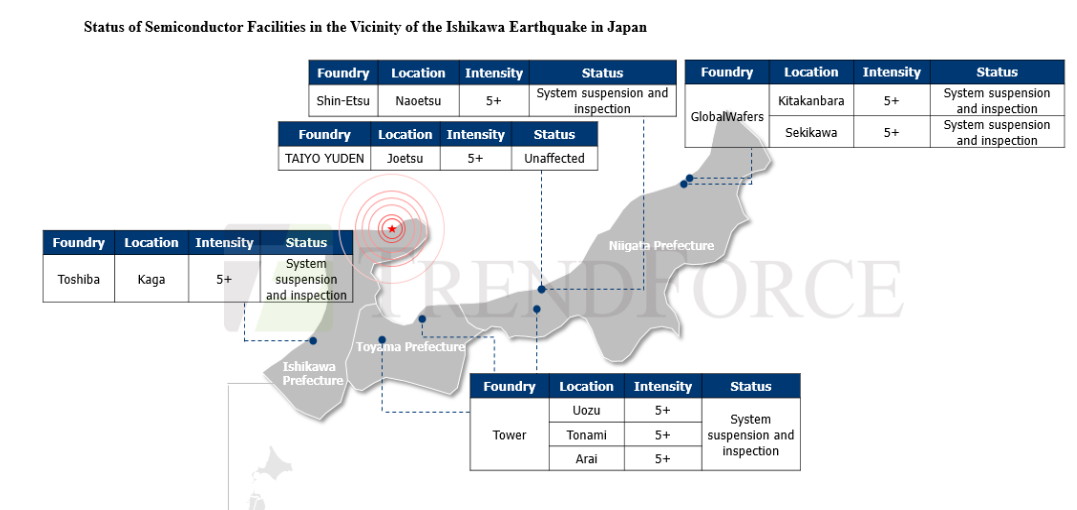
  TrendForce’s investigation into the impact of the recent strong earthquake in the Noto region of Ishikawa Prefecture, Japan, reveals that several key semiconductor-related facilities are located within the affected area. This includes MLCC manufacturer TAIYO YUDEN, silicon wafer (raw wafer) producers Shin-Etsu and GlobalWafers, and fabs such as Toshiba and TPSCo (a joint venture between Tower and Nuvoton).  Given the current downturn in the semiconductor industry and the off-peak season, along with existing component inventories and the fact that most factories are located in areas with seismic intensities of level 4 to 5—within the structural tolerance of these plants—preliminary inspections indicate no significant damage to the machinery, suggesting the impact is manageable.  In terms of silicon wafer production, Shin-Etsu and GlobalWafers' facilities in Niigata are currently shut down for inspection. The crystal growth process in raw wafer manufacturing is particularly sensitive to seismic activity. However, most of Shin-Etsu's crystal growth operations are primarily in the Fukushima area, thus experiencing limited impact from this earthquake. SUMCO reported no effects.  On the semiconductor front, Toshiba's Kaga facility in the southwestern part of Ishikawa Prefecture is currently undergoing inspections. This site includes a six-inch and an eight-inch factory, along with a twelve-inch facility slated for completion in the 1H24. Additionally, the three TPSCo factories in Uozu, Tonami, and Arai—co-owned by Tower and Nuvoton (formerly Panasonic)—are all undergoing shutdowns for inspections. In contrast, USJC (UMC's acquisition of the Mie Fujitsu plant area in 2019) was not affected.  MLCC manufacturer TAIYO YUDEN’s new Niigata plant, designed to withstand seismic activity up to level 7, reported no equipment damage. Murata (MLCC fabs only) and TDK’s MLCC plants experienced seismic intensities below level 4 and were not notably affected. However, Murata’s other factories (Non-Production MLCC) in Komatsu, Kanazawa, and Toyoma, which are in the areas with seismic intensity above 5, were closed for the New Year holiday, and staff are currently assessing any damage.
Key word:
Release time:2024-01-03 16:49 reading:1886 Continue reading>>
GigaDevice partners with SEGGER on Embedded Studio for RISC-V
  GigaDevice and SEGGER jointly announced today that GigaDevice's customers can now use SEGGER's leading multi-platform IDE Embedded Studio free of charge across all GigaDevice RISC-V microcontrollers (MCUs) including the latest GD32VW553.  GigaDevice officially launched the world's first RISC-V based GD32VF103 series of 32-bit general-purpose MCU products in 2019, and very recently introduced the dual-band wireless GD32VW553 series, based on a 160MHz RISC-V core. The device is equipped with 4MB of flash and 320KB of SRAM. GD32VW553 supports the latest Wi-Fi 6 and BLE 5.2 wireless communication protocols. It also integrates rich peripheral interfaces and hardware encryption functions to create a safe and reliable wireless connection solution. High performance and low energy consumption make it ideal for smart home appliances, industrial Internet, communication gateway and other wireless connection scenarios.  Characterized by its flexibility of use, Embedded Studio has all the tools and features a developer needs for professional embedded C and C++ development, including a complete toolchain, optimized run-time library, core simulator and hardware debugging with the J-Link debug probes. Other SEGGER tools that also fully support GD32V RISC-V MCUs include: The market-leading J-Link debug probe, Ozone debugger, real-time operating system embOS and software libraries for communications, data storage, compression, and IoT, as well as the Flasher family of in-circuit programmers.  “GigaDevice and SEGGER have a long history of cooperation”, says Eric Jin, GigaDevice's Product Marketing Director. “SEGGER was the first ecosystem partner to support the GD32V RISC-V core MCUs. Making SEGGER Embedded Studio available to our customers free of charge facilitates software development for our GD32V series. Embedded Studio fully supports and adapts to the GD32V family of RISC-V MCUs in terms of efficiency, performance, and ease of use, significantly accelerating the development and mass production of innovative applications.”  “We have been partners with GigaDevice and have supported GigaDevice products for many years now,“ says Ivo Geilenbruegge, Managing Director of SEGGER. “We immediately added full tool support when they unveiled the first commercially available flash-based RISC-V microcontroller back in 2019. We are impressed by their speed of innovation, the many new devices they have brought to market, and the extent to which they’ve quickly become a key player in the industry.”  For user registration and downloads, visit wiki.segger.com/GD32V now to get Embedded Studio available free of charge for commercial development on GD32V MCUs.  About GigaDevice  GigaDevice Semiconductor Inc. (SSE Stock Code 603986) is a global leading fabless supplier. The company was founded in April 2005 and headquartered in Beijing, China, with branch offices in many countries and regions worldwide, providing local support at customers' fingertips. Committed to building a complete ecosystem with four major product lines – Flash memory, MCU, sensor and analog – as the core driving force, GigaDevice can provide a wide range of solutions and services in the fields of industrial, automotive, computing, consumer electronics, IoT, mobile, networking and communications. GigaDevice has received the ISO26262:2018 automotive functional safety ASIL D certification, as well as ISO9001, ISO14001, ISO45001, and Duns certifications. In a constant quest to expand our technology offering to customers, GigaDevice has also formed strategic alliances with leading foundries, assembly, and test plants to streamline supply chain management. For more details, please visit: www.gigadevice.com.  About SEGGER  SEGGER Microcontroller, now in its fourth decade in the embedded system industry, produces cutting-edge RTOS and Software Libraries, the marketing-leading J-Link and J-Trace debug and trace probes, a fast, robust, reliable, and easy-to-use family of Flasher In-System Programmers and second-to-none software development tools.  SEGGER's all-in-one solution emPower OS provides an RTOS plus a complete spectrum of software libraries including communication, security, data compression and storage, user interface software and more. Using emPower OS gives developers a head start, benefiting from decades of experience in the industry.  SEGGER's professional embedded development software and tools are simple in design, optimized for embedded systems, and support the entire embedded system development process through affordable, high-quality, flexible, and easy-to-use tools.  The company was founded by Rolf Segger in 1992, is privately held, and is growing steadily. SEGGER also has a U.S. office in the Boston area and branch operations in Silicon Valley, Shanghai, and the UK, plus distributors on most continents, making SEGGER’s full product range available worldwide.
Key word:
Release time:2024-01-02 16:39 reading:2478 Continue reading>>
Analog vs. Digital Signals – A Comprehensive Comparison
  In the realm of electronics, the fundamental difference between analog vs digital signals underpins the foundation of modern technology. From audio transmission to data processing, these two signal types play pivotal roles in various applications, each with its unique characteristics and advantages. Delving into the nuances of analog and digital signals unveils their distinct features, applications, and the ongoing debate over which reigns supreme in today’s tech-driven world.  What are Analog and Digital Signals?  Analog Signals:  Analog signals are continuous and fluctuate infinitely within a range, representing physical quantities as a continuous waveform. They take on an infinite number of values within a specified range and are characterized by their smooth, wave-like forms. Examples include the varying voltage in a traditional phone call or the natural world’s continuous phenomena like sound waves and temperature changes.  Digital Signals:  Digital signals, in contrast, are discrete and represent information using binary code—combinations of 0s and 1s. These signals are highly precise, conveying data through distinct and separate values. They are integral to computers, smartphones, and most modern electronic devices, utilizing binary digits to transmit and process information.  FeaturesAnalog Signal:  Infinite Values: Analog signals possess an infinite range of values, offering a complete representation of the original information.  Susceptibility to Interference: They are more prone to interference and degradation over long distances due to environmental factors.  Smooth Continuity: Analog signals exhibit a smooth and continuous waveform, making them ideal for representing natural phenomena accurately.  Digital Signal:  Binary Representation: Digital signals are represented using binary digits (0s and 1s), enabling precise storage and transmission of information.  Immunity to Interference: They are more immune to noise and interference, ensuring data integrity over longer distances.  Ease of Processing: Digital signals facilitate easier and more accurate signal processing, manipulation, and transmission.  Applications and UsesAnalog Signal Applications:  Audio Transmission: Analog signals are prevalent in transmitting audio signals, delivering rich, continuous sound in traditional music players and analog communication systems.  Sensor Readings: Many sensors, like temperature and pressure sensors, produce analog signals to measure and convey real-world data.  Natural Phenomena Representation: Analog signals accurately represent natural occurrences such as light intensity, temperature changes, and more.  Digital Signal Applications:  Computing and Communication: Digital signals form the backbone of modern computing and communication systems, enabling high-speed data transmission and storage.  Media Storage and Playback: Digital signals facilitate the storage and playback of media files, including images, videos, and music, ensuring high fidelity and clarity.  Security and Encryption: Digital signals are crucial in encryption processes, ensuring secure communication and data protection.  Analog vs. Digital Signals – What are the Differences?Analog vs. Digital Signals  The comparison between analog and digital signals often sparks debates regarding superiority. Advocates of analog signals emphasize their ability to represent natural phenomena faithfully, especially in audio and sensory applications. On the other hand, digital signal proponents highlight the precision, ease of processing, and immunity to noise as key advantages.  ConclusionIn conclusion, both analog and digital signals play indispensable roles in various technological applications, each with its unique strengths and areas of application. While digital signals dominate modern electronics and computing due to their precision and robustness, analog signals continue to hold significance in accurately representing continuous, real-world phenomena.
Key word:
Release time:2023-12-29 15:41 reading:2146 Continue reading>>
BIWIN Automotive Storage Solutions: Driving Innovation in Car Electronics
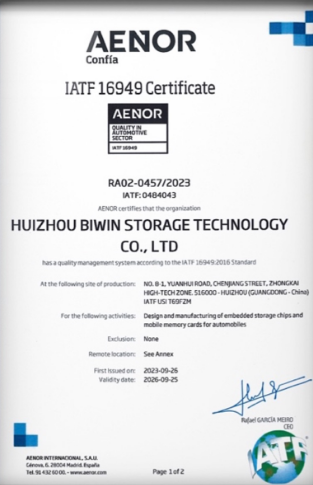
  BIWIN Storage Technology Co., Ltd. (referred to as BIWIN) focuses on the research and development, packaging and testing, and manufacturing of memory chips. It is recognized as a national high-tech enterprise and a national-level specialized and innovative Little Giants enterprise. The company has received strategic investments from the National Integrated Circuit Industry Investment Fund.  BIWIN tightly integrates its operations around the semiconductor memory industry chain, establishing an integrated business model for research and development with packaging and testing. BIWIN possesses core competencies in storage medium characteristic research, firmware algorithm development, chip packaging and testing, test research and development, and global brand operations. BIWIN actively expands into technical domains such as IC design, advanced packaging and testing, and chip testing equipment development.  In 2018, BIWIN achieved IATF 16949:2016 certification for automotive quality management systems--an affirmation of the company's prowess in standardized management, quality control, and technological ingenuity. Recently, BIWIN Huizhou Manufacturing Center of Advanced Packaging and Testing accomplished IATF 16949:2016 certification for the automotive industry quality management systems.  Specializing in advanced packaging and testing, BIWIN demonstrates proficiency in automotive-grade chip testing, supporting both its parent company's automotive-grade chip business and its independent automotive-grade testing outsourcing ventures. The successful IATF 16949:2016 certification holds paramount significance for the company, symbolizing implementing an intelligent management system, establishing automotive-grade quality control and process capabilities, and delivering premium products and services to customers.  Developed by the International Automotive Task Force (IATF) in collaboration with the International Organization for Standardization (ISO) based on ISO 9001:2015, IATF 16949:2016 aims to improve customer satisfaction by ensuring consistent production of high-quality automotive products. It is crucial for automotive companies, including manufacturers, suppliers, and service providers, as it not only indicates compliance with industry-specific quality standards but also encourages the adoption of best practices across the entire supply chain. Obtaining IATF 16949:2016 certification signifies a company's commitment to meeting the highest quality standards. Many globally renowned automotive manufacturers now mandate that their suppliers obtain IATF 16949:2016 certification  Capitalizing on its integrated advantage in research and development, and packaging and testing, BIWIN is strategically expanding its presence in the automotive storage market. Starting from the definition phase, the company meticulously controls each stage of the process according to automotive-grade requirements, including IC design, storage algorithm and firmware development, hardware design, packaging manufacturing, product testing, and safety certification. Tailoring its approach to the specific demands of in-vehicle applications, BIWIN has introduced highly reliable, competitive, and secure automotive-grade storage solutions and services, ensuring a safe driving experience.  Continued Research and Development  Benefiting from years of technical accumulation and experience, BIWIN consistently increases its investment in the research and development of automotive-grade storage. In the field of automotive-grade NAND Flash medium analysis, the company has acquired the capability to analyze storage medium characteristics under automotive-grade conditions, including cross-temperature performance, data retention, read and write interference, and lifespan. In the realm of automotive-grade storage firmware development, BIWIN has mastered reliability protection algorithms such as data loss prevention and data recovery under automotive-grade scenarios, as well as lifespan extension algorithms like wear leveling and write amplification control.  Advanced Packaging and Testing  In the packaging domain, BIWIN excels in the design and simulation of packaging for automotive-grade storage products, along with automotive-grade packaging and testing process capabilities and quality control. In testing, leveraging the rich testing experience and self-developed chip testing equipment and algorithms, the company has established capabilities for high-temperature, ambient-temperature, and low-temperature testing of automotive-grade products, as well as dynamic aging testing. BIWIN can also conduct characteristic analysis and prediction of defective outlier samples based on big data, ensuring automotive-grade yield rates and PPM targets.  Additionally, BIWIN has set up laboratories for design simulation, signal analysis, system verification, reliability testing, material analysis, failure analysis, and more, to comprehensively meet product design and validation needs, continuously forging high-reliability and superior-quality products.  Comprehensive Layout  Presently, the company has launched a series of automotive storage products, including eMMC, UFS, LPDDR, BGA SSD, and SSD, widely applied in automotive information and entertainment systems, advanced driver assistance systems, intelligent cockpit systems, dashcams, panoramic monitoring systems, automotive dashboards, in-vehicle wireless terminals, rail transportation, and more. These products have entered the supply chain systems of leading automotive manufacturers and Tier 1 automotive component suppliers.  In the future, BIWIN will actively deploy and implement integrated R&D and testing 2.0, continuously advancing research and production in automotive-grade storage. Leveraging its profound technical expertise and practical experience in automotive-grade storage, BIWIN will actively deepen cooperation with renowned domestic and international automotive manufacturers. By fully harnessing the strengths and characteristics of all parties involved and achieving deep integration, BIWIN seeks to jointly promote and build a robust brand service, contributing to the rapid development of the automotive industry.
Key word:
Release time:2023-12-28 17:34 reading:2999 Continue reading>>
Fibocom Propels Digitalization of Smart Industry Terminals with Customized PCBA Solutions
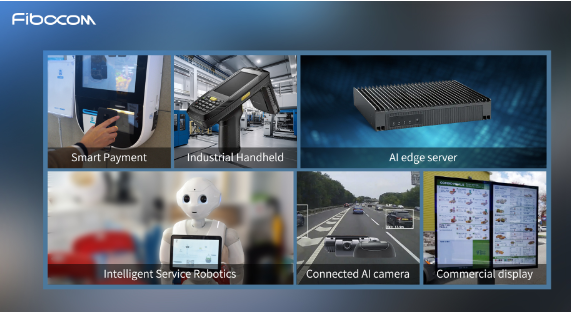
  The PCBA (Printed CircuitBoard Assembly) is the core of electronic devices, combining industry know-how and the assembly of electronic components, which is a pivotal process for device manufacturers in the early stage of product design. By offering the customized PCBA solutions to smart terminal devices such as POS (Point-of-Sale), PoC (Push-to-Talk over Cellular), wearable cameras and more, Fibocom can greatly simplify the manufacturing process, improve efficiency and reduce the time-to-market for industry customers.  Fibocom , a global leading provider of IoT (Internet of Things) wireless solutions and wireless communication modules, announces the fulfillment of its PCBA capability for industry customers in the field of smart payment, industrial handheld, connected AI camera, commercial display, intelligent service robotics, AI edge server, etc. Encompassing hardware design, MD & ID evaluation, algorithm migration & integration, certification, and software application support, the comprehensive PCBA solution drastically expedites the commercialization of customers’ smart devices.  “Driven by the surge in digital transformation across industries, the demand for higher product quality, efficiency, time-to-market, cost-effectiveness, and software-hardware services is burgeoning,” said Ralph Zhao, VP of MC BU at Fibocom. “Leveraging Fibocom’s rich experience in the vertical markets and industry know-how accumulated for more than 24 years, the PCBA solutions are positioned to accelerate digitalization across industries with tailored, high-performance integration. We are confident in assisting our customers to win the market sectors in smart retail, PoC, and wearable cameras through a comprehensive of innovative solutions.”  Enabling Rich Functionalities for POS (Point-of-sale)  Smart payment terminals are evolving into highly integrated devices that adopt various exterior layouts and support rich payment methods such as contactless, QR codes, card payments, etc. Fibocom provides a tailor-made PCBA solution that enables reliable wireless connectivity for POS terminals and supports 720/1080PHD touchscreens with a powerful CPU integrated. In addition to the support of the Android operating system, it allows retailers to upgrade the software through the entire product life cycle and develop the industry applications continuously.  Enabling Robust Roaming and Multimedia Capabilities for PoC (Push-to-Talk over Cellular)  Addressing the requirements for PoC terminal devices, Fibocom offers a comprehensive PCBA solution to reduce the complexity for PoC manufacturers at the early stage of product design. Integrating the cellular capability, multimedia functions, communication protocols, operating systems, and GNSS into the PCBA at a compact size, significantly expedites the timeline of the IoT project, reduces development complexities, and achieves faster time-to-market.  Enabling HD Streaming for Wearable Cameras  The popularity of wearable devices has raised the standard of connectivity and audio-video streaming capabilities, Fibocom’s PCBA solution supports the global 4G/5G cellular roaming, along with Bluetooth/Wi-Fi/NFC for short-distance communication. Additionally, the high-performance graphic engine supports there cording and playback of 4K/1080P video, multi-camera input and output, infrared night vision as well as H.264/H.265 decoding. Leveraging the reliability and scalability of wearable devices, the PCBA solution also provides flexible selections on data storage and peripheral interfaces. The solution can be widely deployed in inspection patrol, transportation, live broadcasting, etc.
Key word:
Release time:2023-12-27 15:56 reading:2947 Continue reading>>
Renesas Launches Cloud-Based Environment to Accelerate Automotive AI Software Development and Evaluation
  Renesas Electronics Corporation (TSE:6723), a premier supplier of advanced semiconductor solutions, today launched a new cloud-based development environment aimed at streamlining the software design process for automotive AI engineers. The new platform, AI Workbench, is an integrated virtual development environment that empowers automotive AI engineers to design, simulate and fine-tune their automotive software - all within the cloud.  With this environment, engineers can immediately begin designing automotive software by leveraging Microsoft Azure services including Azure Compute, IaaS services, Microsoft Entra ID and Azure Security. Instead of installing tools on a PC or obtaining an evaluation board, they can perform tasks such as performance evaluation, debugging and verification using simulation tools online. This approach aligns with the "Shift-Left" approach, which enables software creation and testing earlier in the design cycle, even before the actual hardware becomes available. For example, it is possible to start developing AI-enabled application software to support ADAS (Advanced Driver Assistance System) and autonomous driving for the upcoming fifth-generation R-Car System on Chip (SoC) prior to the availability of hardware samples. This environment will serve as a unified development platform for designing and testing Renesas’ scalable automotive SoCs and microcontrollers (MCUs), regardless of product type or application.  “We are thrilled to introduce a cloud-based virtual development and AI model performance testing environment for automotive AI engineers in collaboration with Microsoft, a leading cloud technology provider," said Mandali Khalesi, Global VP, HPC AI and Cloud Technology at Renesas. “We are committed to improving the AI development environment through new features such as continuous monitoring and analysis of software usage.”  “Cloud-based development is a secure and cost-effective method to address the increasing complexities of today’s embedded projects. The collaboration between Renesas and Microsoft aims to tackle this challenge and accelerate the digital transformation of the automotive industry,” said Ulrich Homann, Corporate Vice President & Distinguished Architect, Cloud + AI, Microsoft. “With Renesas’ AI Workbench, developers can now efficiently build and test software for a myriad of applications using Renesas SoCs in a cloud-based environment powered by Azure."  The AI Workbench includes the following four functional blocks today. Renesas plans to enhance its offering in the future with additional features such as selected functionality or customization options tailored to support various development processes.  Upgraded AI Compiler Toolchain  Renesas will upgrade its SoC AI compiler toolchain with a novel “Hybrid Compiler (HyCo)” architecture and make it available through the AI Workbench. The new HyCo architecture developed in house and kernel libraries will allow engineers to unlock broader AI model and ONNX operator coverage, beyond the coverage of existing-third party hardware accelerator compilers available on Renesas SoC such as DSPs and NPUs.  AI Model Performance Testing Environment  Renesas will provide NNPerf, an online test environment for developers to evaluate the performance of AI models running on live Renesas SoCs with an updated hybrid AI compiler. Testing will run on real hardware in Renesas’ global device farm, without the need for evaluation boards. With the ability to batch code programs, perform real-time inference tests, and compare performance across different AI models, application engineers can estimate and make decisions on tradeoffs between models, memory footprints, latency and more.  Software Development Environment  Microsoft's code editor, Visual Studio Code (VSCode) and a software development kit (SDK) from Renesas are both available in the cloud. Using the tool suite, developers can launch their development environment in the cloud in a matter of minutes. Developers can customize their independent development environment and perform all design work using just a web browser on their PC.  Software Evaluation/Verification Environment  Renesas will also provide an environment for developers to test and verify their application software using the AI models defined in the AI model performance testing tool NNPerf. This includes simulators such as SILS (Software in the Loop Simulator), and HILS (Hardware in the Loop Simulator), allowing users to verify the operation designed for their specific AI application.
Key word:
Release time:2023-12-25 15:41 reading:2479 Continue reading>>
Top Ten IC Design Houses Ride Wave of Seasonal Consumer Demand and Continued AI Boom to See 17.8% Increase in Quarterly Revenue in 3Q23, Says TrendForce
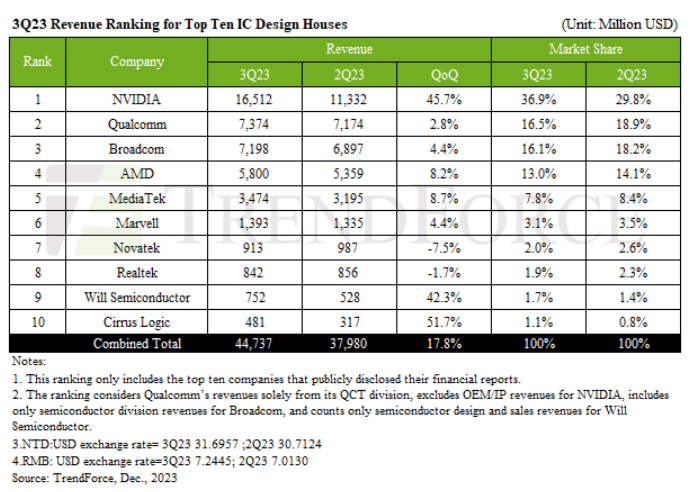
  TrendForce reports that 3Q23 has been a historic quarter for the world’s leading IC design houses as total revenue soared 17.8% to reach a record-breaking US$44.7 billion. This remarkable growth is fueled by a robust season of stockpiling for smartphones and laptops, combined with a rapid acceleration in the shipment of generative AI chips and components. NVIDIA, capitalizing on the AI boom, emerged as the top performer in revenue and market share. Notably, analog IC supplier Cirrus Logic overtook US PMIC manufacturer MPS to snatch the tenth spot, driven by strong demand for smartphone stockpiling.  NVIDIA’s revenue soared 45.7% to US$16.5 billion in the third quarter, bolstered by sustained demand for generative AI and LLMs. Its data center business—accounting for nearly 80% of its revenue—was a key driver in this exceptional growth.  Qualcomm, riding the wave of its newly launched flagship AP Snapdragon 8 Gen 3 and the release of new Android smartphones, saw its third-quarter revenue climb by 2.8% QoQ to around US$7.4 billion. However, NVIDIA’s rapid growth eroded Qualcomm’s market share to 16.5%. Broadcom, with its strategic emphasis on AI server-related products like AI ASIC chips, high-end switches, and network interface cards, along with its seasonal wireless product stockpiling, managed to offset weaker demand in server storage connectivity and broadband. This strategic maneuvering led to a 4.4% QoQ revenue boost to US$7.2 billion.  AMD witnessed an 8.2% increase in its 3Q revenue, reaching US$5.8 billion. This success was due to the widespread adoption of its 4th Gen EPYC server CPUs by cloud and enterprise customers and the favorable impact of seasonal laptop stockpiling. MediaTek's revenue rose by 8.7% to US$3.5 billion in the third quarter, buoyed by a healthy replenishment demand for smartphone APs, WiFi6, and mobile/laptop PMIC components, as inventories across brand clients stabilized.  Cirrus Logic ousts MPS from tenth position thanks to smartphone inventory replenishment  Marvell also made significant gains, with its third-quarter revenue hitting US$1.4 billion, a 4.4% QoQ increase. This growth was primarily driven by increasing demand for generative AI from cloud clients and the expansion of its data center business—despite declines in sectors like enterprise networking and automotive. However, the outlook for some sectors remains mixed, with areas like TV and networking still facing uncertainties, leading to a cautious approach from clients. This resulted in some IC design companies, such as Novatek and Realtek, witnessing a decline in revenues by 7.5% and 1.7%, respectively.  Will Semiconductor benefited from the demand for Android smartphone components, breaking free from past inventory corrections with a 42.3% increase in 3Q revenue to US$752 million. Cirrus Logic, similarly capitalizing on the smartphone component stockpiling trend, saw a significant 51.7% jump in revenue to US$481 million, ousting MPS from the top ten.  In summary, TrendForce forecasts sustained growth for the top ten IC design houses in the upcoming fourth quarter. This optimistic outlook is underpinned by a gradual normalization of inventory levels and a modest seasonal rebound in the smartphone and notebook market. Additionally, the global surge in LLMs extends beyond CSPs, internet companies, and private enterprises, reaching regional countries and small-to-medium businesses, further bolstering this positive revenue trend.
Key word:
Release time:2023-12-22 16:13 reading:2164 Continue reading>>
Integrated circuits vs microcontrollers -what are the differences
  An integrated circuit is an electronic component that integrates multiple electronic devices (such as transistors, resistors, capacitors, etc.) onto a chip to achieve specific functions. The microcontroller is a special integrated circuit that integrates functional modules such as a central processing unit (CPU), memory (RAM, ROM), input/output interfaces and timers and is usually used to control and perform specific tasks. What are the differences between integrated circuits vs microcontrollers? Keep reading!  Integrated CircuitsHistory and Development of Integrated Circuits  Integrated Circuits  The development of integrated circuits (ICs) began in the 1950s. Initially, these circuits consisted of several transistors, resistors, and capacitors mounted on a single silicon chip. With the advent of Moore’s Law, the complexity of integrated circuits has increased rapidly, allowing each silicon chip to accommodate thousands of transistors. This technological advancement has promoted the miniaturization, cost reduction and performance improvement of electronic devices.  Types and Applications of Integrated Circuits  Digital integrated circuits  Digital integrated circuits process digital signals, and they play a central role in devices such as computers, digital storage devices, and mobile phones. These circuits are characterized by high speed and low power consumption. For example, a modern microprocessor is a complex digital integrated circuit that can consume anywhere from a few watts to hundreds of watts and perform billions of operations per second. The cost of manufacturing digital integrated circuits varies depending on the complexity of the design and manufacturing process. Custom chips produced in low volumes can be costly, while standard components produced in large quantities are less costly.  Analog integrated circuit  Analog integrated circuits process analog signals such as sound and radio waves. They are widely used in audio amplifiers, radio receivers and temperature sensors. The power consumption of analog integrated circuits is generally low, usually between milliwatts and several watts. Due to their simpler design and manufacturing processes, the cost is usually lower than that of digital integrated circuits. However, the performance of analog integrated circuits is limited by signal accuracy and noise levels.  Hybrid integrated circuits  Hybrid integrated circuits combine digital and analog technologies and can process digital and analog signals simultaneously. They are particularly important in complex systems such as automotive electronics and mobile communication devices. The cost and performance of hybrid integrated circuits depend on their complexity and application-specific requirements. For example, hybrid integrated circuits used in automotive collision avoidance systems must be very reliable and precise, which can result in higher manufacturing costs.  Integrated circuit applications  Integrated circuits have a wide range of applications. In computer technology, digital integrated circuits are used to process data and control the flow of information. In consumer electronics, such as smartphones and tablets, hybrid integrated circuits are used to process multiple types of signals, such as touchscreen input and wireless communications. In industrial and automotive applications, analog and hybrid integrated circuits are used in monitoring and control systems.  Integrated circuits vs microcontrollers – what are the differencesMicrocontrollers  Function: An integrated circuit is a general electronic component that can be used to implement various functions, such as amplification, filtering, digital processing, etc. The microcontroller is a dedicated integrated circuit specially designed to control and perform specific tasks, such as embedded system control, sensor data processing, etc.  Architecture: Integrated circuits are usually composed of multiple functional modules that can implement various circuit functions. The microcontroller integrates functional modules such as a central processing unit, memory and input/output interface to complete specific control tasks.  Application: Integrated circuits can be used in various electronic devices, such as mobile phones, televisions, computers, etc. Microcontrollers are usually used in embedded systems, such as smart homes, automotive electronic systems, industrial control and other fields.
Release time:2023-12-22 15:58 reading:1755 Continue reading>>
What are diodes in the circuit board?
  PCB diode is one of the most established and most significant electronic gadgets, in spite of the fact that it isn’t quite as well known as its cousin, the semiconductor. Utilized in a wide range of electrical and electronic frameworks, the diode capabilities as a one-way valve for electric flow — it just permits flow to stream in one bearing. This is valuable in changing AC over completely to DC, handling high recurrence signals, controlling voltages, and in different applications.  There are two fundamental sorts of PCB diode. One is an electron tube like the triode. The other kind purposes semiconductors, similar to the semiconductor. Both were concocted from the get-go in the twentieth hundred years.  In this article, you can know everything about PCB diode and related information about this topic.  What are diodes in the circuit board?  A PCB diode is a semiconductor gadget that basically goes about as a one-way switch for current. It permits current to stream effectively in one course, however seriously limits current from streaming the other way.  PCB diode is otherwise called rectifier since it changes substituting current (ac) into throbbing direct current (dc). PCB diode is appraised by their sort, voltage, and current limit.  PCB diode is not set in stone by an anode (positive lead) and cathode (adverse lead). PCB diode permits current to stream just when positive voltage is applied to the anode. An assortment of diode setups are shown in this realistic.  PCB diode is accessible in different setups. From left: metal case, stud mount, plastic case with band, plastic case with chamfer, glass case. A PCB diode is the ‘one way’ sign for electrical circuits. The current is permitted to just travel through the PCB diode in one course. Every diode has a positive end, the anode, and an adverse end, the cathode. Current streams from the anode to the cathode, however not the reverse way around.  Why we should use PCB diodes?  A PCB diode is a gadget that permits current to stream in one heading however not the other. This is accomplished through an underlying electric field. Albeit the earliest diodes comprised of scorching wires going through the center of a metal chamber which itself was situated within a glass vacuum tube, present day diodes are semiconductor diodes. As the name recommends, these are produced using semiconductor materials, principally doped silicon.  The most normal application is by a wide margin the utilization of PCB diode for the correction of AC capacity to DC power. Utilizing diodes, various kinds of rectifier circuits can be made, the most fundamental of which are half wave, full wave community tapped, and full scaffold rectifiers. These are critical in hardware power supplies – for instance, a PC’s charger – where an air conditioner current, which comes from the mains power supply, should be changed over completely to a DC current which can then be put away.  Delicate electronic gadgets should be safeguarded from floods in voltage, and the diode is ideal for this. When utilized as voltage insurance gadgets, PCB diode is nonconducting, notwithstanding, they promptly short any high-voltage spike by sending it to the ground where it can’t hurt delicate coordinated circuits. For this utilization, particular diodes known as “transient voltage silencers” are planned. These can deal with huge power spikes throughout brief time frame periods which would ordinarily harm touchy parts.  Characteristics of diode  Fundamental static attributes of PCB diode are the forward voltage VF and forward current IF, and the opposite voltage and current VR and IR.  The region encompassed by the orange ran line in the chart on the right shows the usable area of amending diodes. In particular, this is the region inside the scope of admissible IF, and inside the breakdown voltage range in the opposite bearing. It ought to be noticed that the region encased by the green ran line is the usable area of Zener diodes, albeit these are not examined in this part. This region isn’t usable for different diodes, and assuming this region is placed unbounded on the IR, gadget disappointment might happen.  Reverse Recovery Time is when, from the state wherein a voltage is applied in the forward heading and forward current In the event that is streaming, the voltage is shifted to the opposite course and the converse current IR gets back to the consistent state (basically zero).  As shown in the graph on the right, when the gadget changes from the ON-state in which an In the event that is streaming to the OFF-state, in a perfect world IF would quickly go to nothing. Yet, in reality, zero is passed, and a converse current IR streams quickly, which recuperates to focus in time Reverse Recovery Time. The more limited Reverse Recovery Time is, the better is the gadget trademark.  The capacitance Ct is the capacitance of the actual diode, and has a similar impact as a capacitor. As in the chart on the right, when a PCB diode is turned here and there, assuming Ct is huge, the supposed adjusting of the waveform turns out to be more articulated, and sometimes there might be the issue that the gadget starts switch off activity before an applied voltage arrives at a full level because of time constants. In a rapid exchanging circuit, diodes with a low Ct are attractive.
Key word:
Release time:2023-12-21 16:23 reading:1671 Continue reading>>
Aluminum-based PCB vs Ceramic-based PCB – A Comprehensive Comparison for Your Electronics
  In the realm of electronics, the choice of printed circuit board (PCB) material plays a pivotal role in determining the functionality, performance, and longevity of electronic devices. Two prominent contenders in this domain are aluminum-based PCBs and ceramic-based PCBs, each with its distinct advantages and specialized applications. Let’s delve deeper into the characteristics, pros, and cons of aluminum-based PCB vs ceramic-based PCB to aid in your decision-making process.  Aluminum-based PCBsAluminum-based PCBs, also recognized as metal core PCBs (MCPCBs), boast a core constructed from an aluminum alloy. These boards have garnered attention for their exceptional thermal conductivity and find extensive usage in applications that demand efficient heat dissipation.  Aluminum-based PCBs  Advantages of Aluminum-based PCBs  Thermal Conductivity: The standout feature of Aluminum-based PCBs is their remarkable thermal conductivity. This property makes them a preferred choice in applications where heat dissipation is critical, such as LED lighting systems, power converters, and automotive electronics. The ability to efficiently transfer heat away from sensitive components ensures enhanced reliability and longevity of the devices.  Cost-Efficiency: Aluminum-based PCBs often present a more budget-friendly option compared to certain high-performance materials. This cost-effectiveness makes them attractive for projects where optimizing expenses without compromising quality is a priority.  Lightweight Nature: Despite their robust construction, Aluminum-based PCBs maintain a relatively lightweight profile. This attribute proves advantageous in applications where weight considerations are pivotal, such as portable electronic devices or aerospace applications.  Manufacturing Simplicity: The manufacturing process for Aluminum-based PCBs is often simpler and more straightforward compared to some other materials, leading to reduced production time and costs.  However, these PCBs do come with their set of limitations, which might impact their suitability for specific applications.  Limitations of Aluminum-based PCBs  Electrical Insulation Requirements: Aluminum-based PCBs necessitate an insulating layer between the circuit and the metal base to prevent short circuits. This requirement adds complexity to the manufacturing process and design considerations, potentially increasing production costs.  Mechanical Strength: While durable, Aluminum-based PCBs might not offer the same level of mechanical strength as Ceramic-based PCBs. This factor could limit their use in applications exposed to harsh physical environments or substantial mechanical stress.  Ceramic-based PCBsCeramic-based PCBs, typically crafted from materials like aluminum oxide or aluminum nitride, have gained prominence owing to their outstanding electrical insulation properties and reliability in diverse applications.  Ceramic-based PCBs  Advantages of Ceramic-based PCBs  Superior Electrical Insulation: The hallmark of Ceramic-based PCBs lies in their superior electrical insulation capabilities. These boards excel in preventing signal interference and short circuits, making them ideal for high-voltage applications where maintaining signal integrity is crucial.  Enhanced Mechanical Strength: Ceramic-based PCBs exhibit greater mechanical strength compared to their Aluminum-based counterparts. This characteristic makes them well-suited for deployment in rugged environments or applications where resistance to mechanical stress is imperative.  High-Frequency Applications: With low dielectric loss and excellent signal integrity properties, Ceramic-based PCBs are highly sought after for high-frequency circuits and radio frequency (RF) applications.  Chemical Resistance: Ceramics demonstrate remarkable resistance to chemicals and corrosion, making Ceramic-based PCBs suitable for applications exposed to harsh and corrosive environments, such as in aerospace or industrial settings.  However, these boards also come with certain limitations that might influence their suitability for specific projects.  Limitations of Ceramic-based PCBs  Cost Considerations: Ceramic-based PCBs typically entail higher manufacturing costs due to the expense of materials and the complexity involved in their production. This factor might limit their feasibility for projects with stringent budget constraints.  Brittleness: Despite their mechanical strength, ceramics can be inherently brittle. Careful handling is required during production, assembly, and installation to prevent breakage, which can add to the overall project timeline and costs.  ConclusionThe choice between Aluminum-based and Ceramic-based PCBs hinges on a comprehensive evaluation of your project’s requirements, budget considerations, and the specific environmental conditions the electronic device will encounter.  For applications where thermal management and cost-effectiveness are paramount, Aluminum-based PCBs might prove more suitable. Conversely, if superior electrical insulation, mechanical robustness, and reliability in harsh conditions are essential, Ceramic-based PCBs could be the preferred option.  Ultimately, consulting with experienced PCB manufacturers or engineers remains pivotal in making an informed decision aligned with the unique demands of your electronic project.
Key word:
Release time:2023-12-15 13:26 reading:1979 Continue reading>>

Turn to

/ 85

  • Week of hot material
  • Material in short supply seckilling
model brand Quote
RB751G-40T2R ROHM Semiconductor
TL431ACLPR Texas Instruments
MC33074DR2G onsemi
BD71847AMWV-E2 ROHM Semiconductor
CDZVT2R20B ROHM Semiconductor
model brand To snap up
IPZ40N04S5L4R8ATMA1 Infineon Technologies
ESR03EZPJ151 ROHM Semiconductor
TPS63050YFFR Texas Instruments
BP3621 ROHM Semiconductor
BU33JA2MNVX-CTL ROHM Semiconductor
STM32F429IGT6 STMicroelectronics
Hot labels
ROHM
IC
Averlogic
Intel
Samsung
IoT
AI
Sensor
Chip

About us

Qr code of ameya360 official account

Identify TWO-DIMENSIONAL code, you can pay attention to

AMEYA360 mall (www.ameya360.com) was launched in 2011. Now there are more than 3,500 high-quality suppliers, including 6 million product model data, and more than 1 million component stocks for purchase. Products cover MCU+ memory + power chip +IGBT+MOS tube + op amp + RF Bluetooth + sensor + resistor capacitance inductor + connector and other fields. main business of platform covers spot sales of electronic components, BOM distribution and product supporting materials, providing one-stop purchasing and sales services for our customers.

Please enter the verification code in the image below:

verification code