
US has a 'concerted strategy' to push allies to reject Huawei's 5G <span style='color:red'>equipment</span>: Eurasia Group
Miquel Benitez | Getty ImagesThe United States is pushing its allies to shut out Chinese tech giant Huawei's 5G networks due to national security concerns as the high-speed technology is set to play a critical role in the 21st century, a Eurasia Group expert said Tuesday.Japan, Washington's close ally, will reportedly stop buying Huawei and ZTE network equipment for government offices and its military forces. Huawei has also been excluded from providing technology for the core 5G network that's being developed by U.K. telecoms firm BT.Australia and New Zealand have also banned Huawei from participating in building their 5G networks — the next generation of mobile technology expected to revolutionize the interaction of internet-connected devices and appliances."This is part of a concerted strategy on the part of the United States to pressure allies, western countries and other like-minded allies not to include Chinese 5G equipment in their next generation networks," Kevin Allison, director of geo-technology at risk consultancy Eurasia Group, said Tuesday on CNBC's "Squawk Box."Allison said that 5G technology is a "geopolitically consequential network upgrade" that represents a new level of innovation with major implications for a number of sectors including driverless vehicles, smart cities, advanced factories and artificial intelligence.Such technologies "are really going to set the tone for the rest of the 21st century," he said, citing intense competition in areas such as the race for faster economic growth and stronger militaries.The U.S. approach to box in Huawei is also a factor in its broader conflict with China over trade, Allison said.Complicating the tariff conflict is Canada's arrest on Dec. 1 of Meng Wanzhou, Huawei's chief financial officer and daughter of company founder Ren Zhengfei, for alleged violation of U.S. sanctions against Iran. The U.S. is seeking her extradition and hearings are ongoing in Vancouver.'Strictly complies'China has strongly criticized the treatment of Meng and summoned the ambassadors of both Canada and the U.S. to complain.Huawei, in a letter to its suppliers released late Thursday, said that it "strictly complies with all applicable laws and regulations in our global business operations" and added it "is not aware of any wrongdoing (by Meng)."Allison predicted that the U.S. effort will result in "a split between a 5G network that is built with Chinese technology in some countries, and networks that are built to be free of Chinese technology in other countries."That echoes the view of former Google top executive Eric Schmidt who said earlier this year that within the next decade there will be two separate internets: one led by the U.S. and the other by China.Key vendors in the 5G network business besides Huawei and fellow Chinese company ZTE include Sweden's Ericsson, Finland's Nokia, South Korea's Samsung, Japan's NEC and Fujitsu, as well as Intel, Qualcomm and Cisco of the United States, according to a Eurasia Group report in November.Josh Kallmer, executive vice president for policy at the Information Technology Industry Council, expressed hope for a system of rules whereby questions of security and competition can be balanced."Certainly there's no more important role for a government than to look after national security but it's also important to pursue these commercial issues in the context of a rules based environment," Kallmer told CNBC."We're confident that if both China and the United States and other markets commit to that, then companies will be able to compete on the merits that everybody will have a fair shake at succeeding — and that's the outcome we should all prefer," he said.
Key word:
Release time:2018-12-12 00:00 reading:1681 Continue reading>>
Japan's top 3 telcos to exclude Huawei, ZTE network <span style='color:red'>equipment</span>: Report
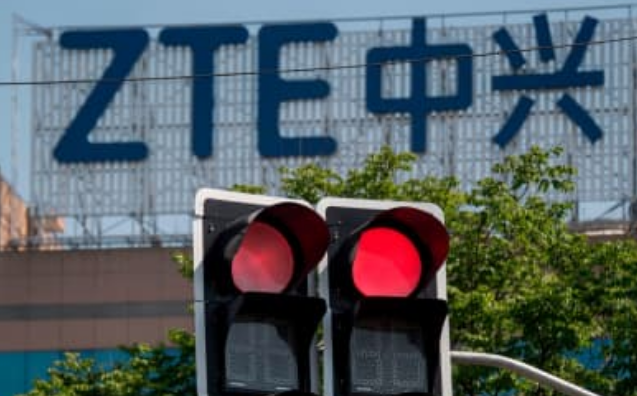
Japan's big three telecom operators plan not to use current equipment and upcoming fifth-generation (5G) gear from China's Huawei Technologies Co Ltd and ZTE Corp, Kyodo News reported on Monday.The news, for which Kyodo did not cite sources, comes at a time of heightened scrutiny of Chinese tech firms by Washington and some prominent allies over ties to the Chinese government, driven by concerns they could be used by Beijing for spying.Johannes Eisele | AFP | Getty ImagesThe ZTE logo is seen on an office building in Shanghai on May 3, 2018.Last week sources told Reuters that Japan planned to ban government purchases of equipment from Huawei and ZTE to ensure strength in its defences against intelligence leaks and cyber attacks.A SoftBank Group Corp spokesman said Japan's third-largest telco was closely watching government policy and is continuing to consider its options. The amount of equipment in use from Chinese makers "is relatively small", he said.The country's top two telecommunications operators, NTT Docomo Inc and KDDI Corp, said the firms had not made any decision yet.Docomo does not use Huawei or ZTE network equipment, but it has partnered with Huawei on 5G trials. KDDI also does not use Huawei equipment in its "core" network, a spokeswoman said, adding it does not use any ZTE network equipment.Huawei did not respond to Reuters request for comment, while ZTE declined to comment.Huawei has already been locked out of the U.S. market, and Australia and New Zealand have blocked it from building 5G networks amid concerns of its possible links with China's government. Huawei has said Beijing has no influence over it.Japan's decision to keep it out would be another setback for Huawei, whose chief financial officer was recently arrested by Canadian officials for extradition to the United States.World financial markets have been roiled since news of the arrest, on worries it could reignite a Sino-U.S. trade row that was only just showing signs of easing.Shares of SoftBank, which has the deepest relationship with Huawei among the big Japanese telcos, fell the most among the three top Japanese telcos on Monday, ending down 3.5 percent.Industry sources said SoftBank would find it difficult to replace pre-existing Huawei network equipment that is designed for the company and not easily interchangable.Docomo and KDDI shares fell around 1 percent, in a wider market that closed down 2 percent.Earlier, SoftBank's Japanese telecoms unit priced its IPO at an indicated 1,500 yen ($13.31) per share and said it will sell an extra 160 million shares to meet solid demand, raising about $23.5 billion in Japan's biggest-ever IPO.
Key word:
Release time:2018-12-11 00:00 reading:1458 Continue reading>>
BT to remove Huawei <span style='color:red'>equipment</span> from its core 4G network: Report
Worldwide semiconductor <span style='color:red'>equipment</span> billings drop to $15.8B in third quarter 2018
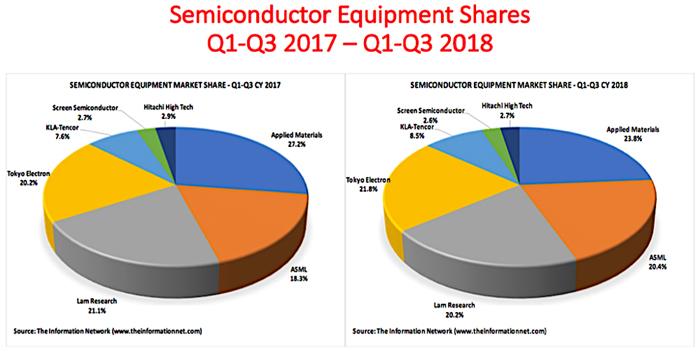
Tokyo Electron Closing in on Applied Materials as Semiconductor Equipment Leader
U.S. asks allies to avoid Huawei's <span style='color:red'>equipment</span>: WSJ
North American semiconductor <span style='color:red'>equipment</span> industry posts October 2018 billings
North American semiconductor <span style='color:red'>equipment</span> industry posts September 2018 billings
Global fab <span style='color:red'>equipment</span> spending to rise by 14%, according to SEMI
  In its Mid-Year Update to the 2018 McClean Report, IC Insights updated its forecast of sales growth for each of the 33 major IC product categories defined by WSTS (Figure 1).  IC Insights now projects that seven product categories will exceed the 16% growth rate expected from the total IC market this year. For the second consecutive year, the DRAM market is forecast to top all IC product segments with 39% growth. Overall, 13 product categories are forecast to experience double-digit growth and 28 total IC product categories are expected to post positive growth this year, down slightly from 29 segments in 2017.  Rising average selling prices for DRAM continued to boost the DRAM market through the first half of the year and into August.  However, IC Insights believes the DRAM ASP (and subsequent market growth) is at or near its peak, as a big rise in DRAM capital expenditures for planned capacity upgrades and expansions is likely put the brakes on steep market growth beginning in 2019.  In second place with 29% growth is the Automotive—Special-Purpose Logic market, which is being lifted by the growing number of onboard electronic systems now found on new cars. Backup cameras, blind-spot (lane-departure) detectors, and other “intelligent” systems are mandated or are being added across all new vehicles—entry level to luxury—and are expected to contribute to the semiconductor content per new car growing to more than $540 per vehicle in 2018.  Wireless Comm—Application-Specific Analog is forecast to grow 23% in 2018, as the world becomes increasingly dependent on the Internet and demand for wireless connectivity continues to rise. Similarly, demand for medical/health electronics systems connectivity using the Internet will help the market for Industrial/Other Application-Specific Analog outpace total IC market growth in 2018.  Among the seven categories showing better than total IC market growth this year, three are forecast to be among the largest of all IC product categories in terms of dollar volume. DRAM (#1 with $101.6 billion in sales), NAND Flash (#2 with $62.6 billion), Computer and Peripherals—Special Purpose Logic (#4 with $27.6 billion) prove that big markets can still achieve exceptional percentage growth.
Key word:
Release time:2018-09-19 00:00 reading:1111 Continue reading>>
Worldwide semiconductor <span style='color:red'>equipment</span> billings reach $16.7B in second quarter 2018

Turn to

/ 4

  • Week of hot material
  • Material in short supply seckilling
model brand Quote
BD71847AMWV-E2 ROHM Semiconductor
RB751G-40T2R ROHM Semiconductor
MC33074DR2G onsemi
TL431ACLPR Texas Instruments
CDZVT2R20B ROHM Semiconductor
model brand To snap up
IPZ40N04S5L4R8ATMA1 Infineon Technologies
BU33JA2MNVX-CTL ROHM Semiconductor
ESR03EZPJ151 ROHM Semiconductor
STM32F429IGT6 STMicroelectronics
BP3621 ROHM Semiconductor
TPS63050YFFR Texas Instruments
Hot labels
ROHM
IC
Averlogic
Intel
Samsung
IoT
AI
Sensor
Chip

About us

Qr code of ameya360 official account

Identify TWO-DIMENSIONAL code, you can pay attention to

AMEYA360 mall (www.ameya360.com) was launched in 2011. Now there are more than 3,500 high-quality suppliers, including 6 million product model data, and more than 1 million component stocks for purchase. Products cover MCU+ memory + power chip +IGBT+MOS tube + op amp + RF Bluetooth + sensor + resistor capacitance inductor + connector and other fields. main business of platform covers spot sales of electronic components, BOM distribution and product supporting materials, providing one-stop purchasing and sales services for our customers.

Please enter the verification code in the image below:

verification code