3Q18 Contract Price Hike for Server <span style='color:red'>DRAM</span> Limited Due to Improved Supply, Says TrendForce
The shortfall in the supply of server DRAM may ease in the second half, as evidenced by the increasing average shipment fulfillment rate in the past several quarters, according to DRAMeXchange, a division of TrendForce.As a result, following the 10% sequential hike in contract prices in the first half, the average shipment fulfillment rate has topped 80% now, thanks to the adjustment of output share of server DRAM by DRAM suppliers, which has helped to ease the tight supply situation, says Mark Liu, the senior analyst of DRAMeXchange.DRAMeXchange points out that the prices of 32 GB server modules to be shipped to the first-tier firms in Q3 may advance by 1-2% to US$320. Meanwhile, second-tier makers will become benefited thanks to increased shipment fulfillment rates. Consequently, the range of quotes for Q3 contract prices will be limited.Meanwhile, affected by the increased penetration rates of Intel’s Purley and AMD’s Naples platform, the average density and penetration rate of 32 GB product lines will increase in the second half, sustaining the demands for server DRAM. The stocking-up demands for Intel's new solutions will remain robust, with shipment still mainly for data centers in North America and China. The penetration rate of Intel’s Purley platform is expected to approach 80% in Q4, up from over 50% now, while penetration rate of 32 GB server modules will exceed 70% by the end of the year, according to DRAMeXchange.In terms of the development of process technology, 20 nm will remain the mainstream process for DRAM this year and stocking-up demands for high-density server modules will continue to the end of the year, thanks to the effect of new platform solutions. Currently, the share of products featuring advanced process remaining low. In addition, die shrink technology will become increasingly complicated after the migration to 17 nm and 18 nm processes. Therefore, except Samsung which has applied 18 nm process in the mass production of server products, other DRAM suppliers will not begin increasing the share of products with advanced process until Q4, due to the consideration of product reliability.
Key word:
Release time:2018-06-25 00:00 reading:1213 Continue reading>>
<span style='color:red'>DRAM</span> price increase might be restrained by China’s Ministry of Commerce
Investigations are currently underway to determine whether or not there has been foul play among the top three memory manufacturers, after Samsung, SK Hynix and Micron were accused of fixing the prices of DRAM and NAND memory throughout 2017. This has prompted China’s Ministry of Commerce to step in and express concerns over the ever-rising prices of DRAM, potentially imposing a restriction.China has a rather large stake when it comes to importing memory product, with TrendForce reporting that the nation consumes 20 percent of the world’s DRAM and 25 percent of NAND. As China’s R&D plays catch up for the country to build its own domestic production, an increased focus has naturally been placed on the regulation of DRAM to enable fair competition in the market.While there has been no evidence made public from last year’s investigation conducted by China’s National Development and Reform Commission (NDRC) regarding memory price fixing, the whopping first quarter market share increase has put memory manufacturers in the country’s crosshairs, as the Anti-Monopoly Bureau of Ministry of Commerce held a meeting with Micron last week.China is keen to find answers in order to alleviate component cost pressure from Chinese PC OEMs, as well as getting to the bottom of the staggering 44.9%, 27.9%, and 22.6% increased shares across Samsung, SK Hynix and Micron respectively. A 96 percent increase suggests that the three hold an oligopoly in the DRAM market, which has led to some discussion of restraining price increases.All three companies are currently the target of a class action lawsuit in the United States, highlighting the sudden 47 percent spike in DRAM pricing in 2017 after a steadily sustained growth in the market between 2012 to 2016. Samsung and SK Hynix have tried to bolster their efforts with supply in order to meet demand with a combined £30 billion investment. Such a boost to the supply chain would eventually lead to prices coming back down, but it will be a while before we see the results.
Key word:
Release time:2018-05-30 00:00 reading:1131 Continue reading>>
China Meets With Micron Over <span style='color:red'>DRAM</span> Price Increases
It's certainly not news to enthusiasts that sky-high RAM pricing continues, but luckily government agencies and law firms are taking notice. China is ratcheting up the pressure on DRAM vendors as the memory shortage, and resulting price hikes, continue. The country is also fostering its own domestic DRAM production to head off future supply shortages.According to a new report from TrendForce's analyst outfit DRAMeXchange, Micron has met with China's Anti-Monopoly Bureau of Commerce to answer questions regarding the continued increase in DRAM pricing. These same concerns are at the heart of a looming class-action lawsuit from the U.S.-based Hagens Berman firm, which contends that the leading memory producers are engaging in DRAM price fixing.China is the world's largest consumer of memory chips, currently absorbing roughly 20% of the world's NAND and DRAM, which it then turns into products that it primarily exports to the rest of the world. As such, the continuing price hikes for DRAM have a profound impact on many of its bread and butter segments, such as smartphone production.China has taken notice of the other DRAM players, too. The Micron meetings come after China's meetings with Samsung in December, which was precipitated by requests from smartphone makers to investigate the company for monopolistic practices pertaining to memory pricing. Samsung later signed a new Memorandum of Agreement (MOU) with China, which finds the company investing and cooperating in developing next-gen technologies with the country. Many analysts have speculated the extension of the existing agreement, which had expired, was meant to assuage China's regulatory agencies.According to DRAMeXchange, China's meetings with Samsung earlier this year should lead to some moderation in increasing prices for DRAM, and the country's intervention may result in increased production.Micron is the smallest player in the DRAM market, accounting for 22.6% of global supply, while Samsung and SK Hynix both hold larger shares. There haven't been any reports of meetings with South Korean chipmaker SK Hynix, but given the current climate, we expect China will soon aim its pointed questions at that company, too.DRAM production is a capital- and time-intensive exercise, so it could be nearly a year before any changes to the dominant players’ production plans have an impact on inflated pricing.Meanwhile, China's own domestic memory production is beginning to take flight. Fujian Jinhua Integrated Circuit Co. (JHICC) is one of the emerging Chinese memory producers. China is also concerned that Micron is blocking the supply of equipment to JHICC, which has been targeted by Micron in the past for infringing on its patents. Given the country's government-backed initiatives to bolster indigenous chip production, China is taking a keen interest in the dispute.Most of China's domestic DRAM production is expected to be sold in-country, as it might not pass muster for the international market due to possible patent violations. As a result, we might not see some of the familiar Chinese tactics, such as price dumping in international markets. In either case, the government-backed production is expected to offset some of China's memory imports, which would eventually result in cheaper chips for everyone.
Key word:
Release time:2018-05-28 00:00 reading:1250 Continue reading>>
Global Mobile <span style='color:red'>DRAM</span> Revenue Reached a New Record High in 1Q18
DRAMeXchange, a division of TrendForce, reports that smartphone brands had then spent three months adjusting their inventories before they again started to stock up on components toward the end of February 2018, when the end demand also began to bounce back. Much of the stock-up demand has been related to high-density memory components for new flagship smartphones that are to be released in 1H18. Revenue-wise, mobile DRAM suppliers in 1Q18 benefitted from new product releases, demand recovery in the smartphone market (since the middle of the quarter), and the increase in quotes. As a result, the global mobile DRAM revenue rose by 5.3% QoQ against seasonal headwinds to a new record high of US$8.435 billion.The mobile DRAM market will be seeing a moderation of the price upswing in 2Q18. Nevertheless, demand from major Chinese smartphone brands, Huawei, Xiaomi, OPPO and Vivo, remains strong. Apple will raise the memory densities of iPhone models for 2018. Android phone makers, too, will do the same for their devices that are set for release this year. DRAMeXchange thus forecasts that the global mobile DRAM revenue will maintain QoQ growth in 2Q18 and again achieve a new record high.Samsung was still the overall revenue leader in 1Q18. However, Samsung’s quoting has become more conservative during 1Q18 and 2Q18 compared with the prior quarters due to the investigation by China’s National Development and Reform Commission. To get around the constraints that are imposed on its pricing strategy, Samsung has been aggressively promoting high-density products together with its advanced manufacturing technology.Samsung was again at the top of the mobile DRAM revenue ranking for 1Q18 with a total of US$4.766 billion, as the company was successful in winning orders for high-density products. On the technology front, Samsung’s deployment of its 18nm process now extends to almost all of its mobile DRAM product lines. Only a few LPDDR3 eMCP lines are still produced on the older 20nm process.SK Hynix’s mobile DRAM revenue for 1Q18 increased by just 2.2% QoQ despite the general upswing in contract prices. The marginal growth was attributed to the issues with raising the yield rate and production capacity of the 18nm process, which is still at the initial stage of development. Because of the challenges with the 18nm, SK Hynix could not increase its shipments of high-density LPDDR4 components for flagship smartphones in 1Q18.Currently, the 21nm process and the 25nm shrink process are still the main technologies that SK Hynix use for manufacturing LPDDR4 and LPDDR3 series, respectively. The portion of 18nm products in SK Hynix’s mobile DRAM portfolio (including discrete and eMCP) is not expected to increase noticeably until 3Q18. Also, the penetration rate of the 18nm technology in the manufacturing of the supplier’s mobile DRAM for the entire 2018 may be less than 10%.Micron’s mobile DRAM revenue for 1Q18 went up by 10.2% QoQ to US$1.408 billion, showing the largest increase among the top three suppliers. Micron’s impressive result was based on the strong overall demand and the persistent price upswing. In terms of technology development of Micron’s subsidiaries, Micron Memory Taiwan (formerly Rexchip) in 2Q18 will continue to increase the share of 17nm process in its mobile DRAM production.On the other hand, Micron Technology Taiwan (formerly Inotera) mainly produces mobile DRAM on the 20nm process for now. As for product planning, Micron’s mainstream offerings for the mobile application will soon make the switch from the LPDDR3 series to the LPDDR4 series, which is projected to represent more than 50% of the supplier’s total mobile DRAM output (including the output of both subsidiaries) for the whole 2018.Regarding Taiwan-based suppliers, Nanya’s mobile DRAM revenue for 1Q18 advanced significantly by 19.1% QoQ to US$96 million. Nanya expanded shipments of its LPDDR3 4Gb chips in 1Q18 because many IDHs (independent design houses) have chosen discrete packages (i.e. discrete DRAM plus discrete NAND Flash) over eMCPs due to considerations over BOM (bill of materials) costs. This in turn contributed to the strong revenue growth. In terms of technological development, Nanya is still mainly using the 30nm shrink process for the manufacturing of its mobile DRAM products.However, the company will expand the deployment its 20nm process in the mobile DRAM production in order to increase the profit margin. Winbond’s revenue performance was fairly stable in1Q18, registering a quarterly increase by 1.2% from 4Q17 to a total of US$44 million. Winbond’s mobile DRAM offerings are more limited in their application scopes, so the demand for them have not risen sharply.
Key word:
Release time:2018-05-22 00:00 reading:1249 Continue reading>>
Three Major Server <span style='color:red'>DRAM</span> Suppliers Score 10.3% Revenue Growth in 1Q18
Despite the recent adjustments of product mix by suppliers, the supply of server DRAM remained tight in 1Q18, thus resulting in high average selling prices. Consequently, the total revenue of the three major server DRAM suppliers rose by 10.3% sequentially in 1Q18 to US$6.975 billion, according to DRAMeXchange, a research division of TrendForce.According to Mark Liu, senior analyst at DRAMeXchange, it is noteworthy that even with the influx of orders from data centers, the average share of advanced processes of server DRAM has remained low, as Samsung is the only supplier in the industry to have successfully expanded the share of its 18 nm technology in 2018. The migration of SK Hynix and Micron to the 18 nm and 17 nm manufacturing processes, respectively, have been constrained by their limited yield rates in Q1. Overall speaking, server DRAM supply is likely to witness an improvement in 2H18, following the inauguration of some new capacities and adjustments in product mix which will lead to higher product penetration rates.With the average content per box of server DRAM increasing along with the higher penetration rates of Intel’s Purley platform, the utilization rates of high-density and high-transmission server modules, such as DDR4 32 GB RDIMM 2666 MHz, picked up significantly in Q1 this year. The average margins of the three major DRAM suppliers for server DRAM also rose further.Samsung racked up 44.6% share on the server DRAM market in Q1, with revenues rising by 6.5% sequentially to US$3.108 billion. In terms of product development, the company has been focused on the market penetration rates of products featuring the 18 nm process, which will account for around 70% of its output by the end of this year, up from 50% now. Its focus on the advanced 18nm process has allowed it to maintain a massive lead over rivals in the cost structure and margin of server DRAM, as products based on 18 nm technologies enjoy a 20% improvement in cost over 20 nm products.In the second half, Samsung’s overall margins will also benefit from the successive launch of new DRAM capacity and continuing strong demand for contract production from data centers.SK Hynix staged a brilliant performance in Q1, when the company's overall server DRAM revenues advanced by 13.2% QoQ to US$2.251 billion, due to the large-scale shift of its capacity to server products at the end of last year, and the continuous rise of Server DRAM ASP in Q1.With regard to the company’s capacity planning, the share of SK Hynix’s cutting-edge process is still relatively low despite facing a continuous influx of server orders. Its products based on the 18 nm process accounting for a minor share in output, and the 21 nm process is expected to remain the mainstream technology for SK Hynix in the second half of this year.With strained supply boosting the sequential growth of server DRAM bit shipments, and larger-scale increases in quotes than Samsung and SK Hynix, Micron racked up US$1.616 billion in revenues for server DRAM products in Q1, a growth of 14.3% QoQ.Benefiting from the partial penetration of its 17 nm process and increased output of high-density modules, the overall sales of Micron scored significant improvements, with much of the growth coming from US data centers. Products with the 17 nm process is currently unlikely to be mass production until the first half of this year, as some problems remain unsolved.
Key word:
Release time:2018-05-17 00:00 reading:1417 Continue reading>>
<span style='color:red'>DRAM</span> Revenue in 1Q18 Rose by 5.4% QoQ to Another Record High as the Upswing of ASPs Continued
DRAMeXchange, a division of TrendForce, reports that the global DRAM revenue for 1Q18 rose by 5.4% QoQ to a new record high. Prices of graphics DRAM products rose significantly by 15% QoQ in 1Q18, given the relatively low base and the surge of demand from the cryptocurrency mining market. Prices of DRAM products for other application markets also increased by 3-6% QoQ.According to Avril Wu, senior research director of DRAMeXchange, most PC-OEMs have concluded negotiating their procurement contracts for 2Q18. The average quote of mainstream PC DRAM modules from the first-tier DRAM suppliers came to US$34 this April, showing a 3% increase from the average price in 1Q18. From the perspective of the market, DRAM suppliers have kept a greater share of their capacity for server memory products, which are generally seeing greater demand, higher gross margins, and higher profitability. Furthermore, first-tier DRAM suppliers will gradually start using their expanded capacity later, toward the end of 2018. Hence, prices of PC DRAM products will stay on an uptrend in 2Q18.Revenue-wise, Samsung was firmly the leader in the industry, with a new record high set. Specifically, Samsung’s 1Q18 revenue rose by 2.9% QoQ to US$10.36 billion. SK Hynix’s revenue from the same period also advanced by 2.2% QoQ to US$6.43 billion. Product shipments from the top two South Korean suppliers slipped a bit in 1Q18 because of the weak smartphone market. Consequently, their combined global market share in revenue terms also decreased slightly from the prior quarter to around 73% in 1Q18. Respectively, Samsung’s market share came to 44.9%, while SK Hynix’s was 27.9%.Micron remained third place in the revenue ranking but has been the price leader so far in 1H18 as the company is keen on raising quotes. Compared with Samsung and SK Hynix, Micron’s price hikes were noticeably larger in 1Q18, surpassing 10% QoQ on average. As a result, Micron’s 1Q18 revenue reached US$5.21 billion, up by 14.3% QoQ. Micron also expanded its market share by two percentage points from the prior quarter to 22.6%.Regarding the operating margins of the top three suppliers, Samsung again broke its previous record in 1Q18. Samsung’s operating margin grew significantly from 64% in 4Q17 to 69% in 1Q18. SK Hynix, too, expanded its operating margin from 59% in 4Q17 to 61% in 1Q18. Both the top two South Korean suppliers have pushed their respective operating margins over the 60% level. Micron’s operating margin in 1Q18 came to 58%, which was also a marked increase from the 53% of 4Q17. Going forward, the general price increase and the cost improvements in connection with technological advances are expected to keep driving profit for the top three suppliers and take their operating margins to new highs in 2Q18. However, the profitability of the top suppliers is also far exceeding the buyers’ acceptable limit. For example, Samsung’s operating margin in 1Q18 translates to a gross margin surpassing 80%. This implies that the hikes in quotes will likely start to moderate.With respect to the technological development, Samsung is consistent with its objective of maintaining its 18nm output share at 50-60%. The DRAM line on the second floor of Samsung’s Pyeongtaek plant is being readied for production and will represent the company’s transition to its next-generation 16nm process. SK Hynix is currently focus on raising the yield rate of its 18nm process that entered production at the end of last year. Nevertheless, the supplier is finding that the transition to the next-generation 1X nm processing is more difficult than anticipated. SK Hynix is sticking to the same capacity expansion plan, so its second fab in Wuxi is on track to finish construction at the end of 2018 and will be in operation in 1H19 at the earliest. As for Micron, its subsidiary Micron Memory Taiwan (formerly Rexchip) is now totally producing on the 17nm process. The other subsidiary Micron Technology Taiwan (formerly Inotera) has begun the migration from the 20nm to the 17nm in 2Q18 and will gradually ramp up the 17nm production in 2H18.The latest survey of Taiwan-based suppliers finds that Nanya saw a substantial increase in its DRAM revenue in 1Q18, up by 15.1% QoQ. Nanya’s strong performance was mainly attributed to the bit supply growth and cost reduction resulting from the migration to the 20nm process, which contributed to an increase of five percentage points in operating margin from the prior quarter to 44.3% in 1Q18. Nanya’s profit will keep going up as the company improves the yield rate of its 20nm process and optimizes its product mix.Powerchip’s 1Q18 DRAM revenue rose by 8.2% QoQ as the company has also raised its quotes. Additionally, Powerchip continues to see growth in its foundry business that serves IC design houses such as ESMT and AP Memory. Winbond’s DRAM revenue rose slightly in 1Q18 by just 1.2% QoQ. Winbond registered flat growth because the price hikes of its specialty DRAM products were relatively small.
Key word:
Release time:2018-05-15 00:00 reading:1265 Continue reading>>
Are the Major <span style='color:red'>DRAM</span> Suppliers Stunting <span style='color:red'>DRAM</span> Demand?
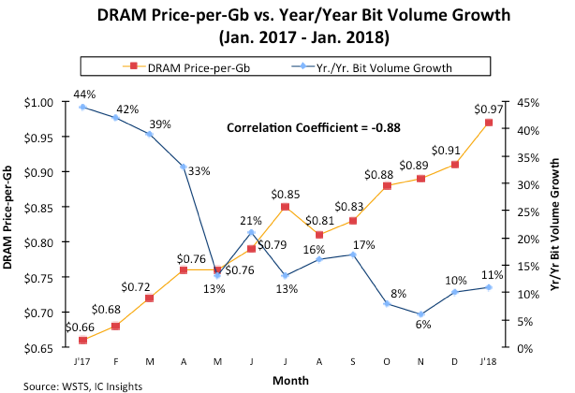
  Skyrocketing DRAM prices potentially open the door for startup Chinese competitors.  Historically, the DRAM market has been the most volatile of the major IC product segments.  A good example of this was displayed over the past two years when the DRAM market declined 8% in 2016 only to surge by 77% in 2017!  In the 34-year period from 1978-2012, the DRAM price-per-bit declined by an average annual rate of 33%. However, from 2012 through 2017, the average DRAM price-per-bit decline was only 3% per year.  Moreover, the 47% full-year 2017 jump in the price-per-bit of DRAM was the largest annual increase since 1978, surpassing the previous high of 45% registered 30 years ago in 1988!  In 2017, DRAM bit volume growth was 20%, half the 40% rate of increase registered in 2016.  For 2018, each of the three major DRAM producers (e.g., Samsung, SK Hynix, and Micron) have stated that they expect DRAM bit volume growth to once again be about 20%.  However, as shown in Figure 1, monthly year-over-year DRAM bit volume growth averaged only 13% over the nine-month period of May 2017 through January 2018.  Figure 1 also plots the monthly price-per-Gb of DRAM from January of 2017 through January of 2018.  As shown, the DRAM price-per-Gb has been on a steep rise, with prices being 47% higher in January 2018 as compared to one year earlier in January 2017.  There is little doubt that electronic system manufacturers are currently scrambling to adjust and adapt to the skyrocketing cost of memory.  DRAM is usually considered a commodity like oil.  Like most commodities, there is elasticity of demand associated with the product.  For example, when oil prices are low, many consumers purchase big SUVs, with little concern for the vehicle’s miles-per-gallon efficiency.  However, when oil prices are high, consumers typically look toward smaller or alternative energy (e.g., hybrid or fully electric) options.  Figure 1  While difficult to precisely measure, it is IC Insights’ opinion that DRAM bit volume usage is also affected by elasticity, whereby increased costs inhibit demand and lower costs expand usage and open up new applications.  As shown in Figure 1, the correlation coefficient between the DRAM price-per-bit and the year-over-year bit volume increase from January 2017 through January 2018 was a strong -0.88 (a perfect correlation between two factors moving in the opposite direction would be -1.0).  Thus, while system manufacturers are not scaling back DRAM usage in systems currently shipping, there have been numerous rumors of some smartphone producers scaling back DRAM in next-generation models (i.e., incorporating 4GB of DRAM per smartphone instead of 5GB).  In 2018, IC Insights believes that the major DRAM suppliers will be walking a fine line between making their shareholders even happier than they are right now and further alienating their customer base.  If, and it is a BIG if, the startup Chinese DRAM producers can field a competitive product over the next couple of years, DRAM users could flock to these new suppliers in an attempt to get out from under the crushing price increases now being thrust upon them—with the “payback” to the current major DRAM suppliers being severe.
Key word:
Release time:2018-03-09 00:00 reading:1507 Continue reading>>
Value of Semiconductor Industry M&A Deals Slows Dramatically in 2017
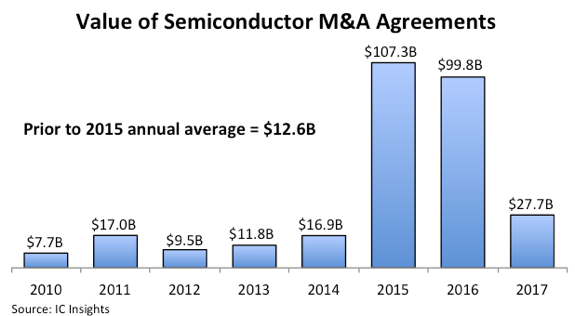
  Numerous smaller deals were made but “megadeals” were scarce last year.  The historic flood of merger and acquisition agreements that swept through the semiconductor industry in 2015 and 2016 slowed significantly in 2017, but the total value of M&A deals reached in the year was still more than twice the annual average in the first half of this decade, according to IC Insights’ new 2018 McClean Report, which becomes available this month.  Subscribers to The McClean Report can attend one of the upcoming half-day seminars (January 23 in Scottsdale, AZ; January 25 in Sunnyvale, CA; and January 30 in Boston, MA) that discuss the highlights of the report free of charge.  In 2017, about two dozen acquisition agreements were reached for semiconductor companies, business units, product lines, and related assets with a combined value of $27.7 billion compared to the record-high $107.3 billion set in 2015 and the $99.8 billion total in 2016 (Figure 1).  Prior to the explosion of semiconductor acquisitions that erupted several years ago, M&A agreements in the chip industry had a total annual average value of about $12.6 billion between 2010 and 2015.                     Figure 1  Two large acquisition agreements accounted for 87% of the M&A total in 2017, and without them, the year would have been subpar in terms of the typical annual value of announced transactions.  The falloff in the value of semiconductor acquisition agreements in 2017 suggests that the feverish pace of M&A deals is finally cooling off. M&A mania erupted in 2015 when semiconductor acquisitions accelerated because a growing number of companies began buying other chip businesses to offset slow growth rates in major end-use applications (such as smartphones, PCs, and tablets) and to expand their reach into huge new market opportunities, like the Internet of Things (IoT), wearable systems, and highly “intelligent” embedded electronics, including the growing amount of automated driver-assist capabilities in new cars and fully autonomous vehicles in the not-so-distant future.  With the number of acquisition targets shrinking and the task of merging operations together growing, industry consolidation through M&A transactions decelerated in 2017.  Regulatory reviews of planned mergers by government agencies in Europe, the U.S., and China have also slowed the pace of large semiconductor acquisitions.  One of the big differences between semiconductor M&A in 2017 and the two prior years was that far fewer megadeals were announced.  In 2017, only two acquisition agreements exceeded $1 billion in value (the $18 billion deal for Toshiba’s memory business and Marvell’s planned $6 billion purchase of Cavium).  Ten semiconductor acquisition agreements in 2015 exceeded $1 billion and seven in 2016 were valued over $1 billion.  The two large acquisition agreements in 2017 pushed the average value of semiconductor M&A pacts to $1.3 billion.  Without those megadeals, the average would have been just $185 million last year.  The average value of 22 semiconductor acquisition agreements struck in 2015 was $4.9 billion.  In 2016, the average for 29 M&A agreements was $3.4 billion, based on data compiled by IC Insights.  Report Details:  The 2018 McClean Report  Additional details and forecasts for the worldwide IC market through 2022 are included in the new 2018 edition of IC Insights’ flagship report, The McClean Report—A Complete Analysis and Forecast of the Integrated Circuit Industry.  A subscription to The McClean Report includes free attendance to one of the upcoming half-day seminars (January 23 in Scottsdale, AZ; January 25 in Sunnyvale, CA; and January 30 in Boston, MA) that discuss the highlights of the report, free monthly updates from March through November (including a 250+ page Mid-Year Report), and free access to subscriber-only webinars throughout the year.  An individual-user license to the 2018 edition of The McClean Report is priced at $4,290 and includes an Internet access password.  A multi-user worldwide corporate license is available for $7,290.
Key word:
Release time:2018-02-12 00:00 reading:1222 Continue reading>>
Samsung develops 'world's smallest' <span style='color:red'>DRAM</span> chip
  Samsung Electronics says it has developed the world’s smallest DRAM chip, in a move that widens its technical lead over its competitors. The move comes as the South Korean giant is expected to announce record operating profits for 2017.  The 'second-generation' 10nm-class, 8Gbit DRAMs combine improved energy efficiency and data processing performance and are intended for cloud computing centres, mobile devices and high-speed graphic cards, according to Samsung. The company also said that it would be moving most of its existing DRAM production capacity to 10nm-class chips in 2018.  This 'aggressive' production expansion would 'accommodate strong market demand', said Gyoyoung Jin, president of Samsung Electronics' memory business.  The company said that it was not looking to expand chip shipments immediately, but was investing to maintain longer-term market position.  The chips deliver a 30% ‘productivity gain’ over Samsung's 1st-generation devices and the latest 8Gbit DDR4 can transmit data a 3.60Gbit/s per pin, compared to 3.2Gbit/s for the 1x-nm 8Gbit DDR4.  Samsung has applied new technologies to achieve this improvement, including the use of a high-sensitivity cell data sensing system and a progressive 'air spacer' scheme.  A newly devised data sensing system enables a more accurate determination of the data stored in each cell, which leads to a significant increase in the level of circuit integration and manufacturing productivity, while an air spacer has been placed around bit lines to decrease parasitic capacitance. Use of the air spacer enables not only a higher level of scaling, but also rapid cell operation.
Key word:
Release time:2017-12-27 00:00 reading:1484 Continue reading>>
Samsung in Production of Second-gen 10nm <span style='color:red'>DRAM</span>
  South Korea's Samsung Electronics said it has commenced production of the second generation of its 10nm-class 8-Gb DDR4 DRAM. The chips achieve speeds of up to 3,600 megabits per second (Mbps) and are produced without the need for extreme ultraviolet (EUV) lithography.  Gyoyoung Jin, president of Samsung's memory business, said through a press statement that new technologies in DRAM circuit design and process technology enabled Samsung to break through "a major barrier for DRAM scalability." To meet booming market demand, he said Samsung would rapidly ramp up its second-generation 10nm-class DRAM production and also aggressively expand production of the first generation of the chips.  Devices labeled 10nm-class have feature sizes as small as 10 to 19 nanometers.  The market for DRAM chips has been robust all year, as demand growth has outstripped supply and led to continual price increases. According to market research firm IC Insights, the DRAM market will grow by 74 percent this year, its largest rate of expansion since 1994.  Samsung is planning to begin transitioning to EUV for logic chips next year at the 7nm node, although it is unclear when the technology will be put into production for DRAM. Because of the relative structural simplicity of DRAM cells, it is generally accepted that it will require EUV later than other types of devices.  Samsung said it is able to produce second-generation 10nm-class DRAMs that achieve speed, performance and efficiency advantages over first-generation devices by employing advanced techniques, including a high-sensitivity cell data sensing system and a progressive “air spacer” scheme.  The data sensing system enables a more accurate determination of the data stored in each cell, increasing the level of circuit integration and manufacturing productivity, Samsung said. Meanwhile, placing an air spacer around bit lines decreases parasitic capacitance, enabling a higher level of scaling and rapid cell operation, according to the company.  Samsung claims its second-generation 10nm-class 8Gb DRAM boasts about 30 percent better productivity than the first generation of the chips, while also offering performance and energy efficiency advantages of 15 and 10 percent, respectively. The new devices can operate at 3,600 Mbps per pin, up from about 3,200 Mbps for the first-generation chips, which have been in production since 2016.  The innovations used in the second-generation 10nm-class DRAMs will enable Samsung to accelerate its plans for faster introductions of future DRAM chips, including DDR5, HBM3, LPDDR5 and GDDR6, the company said.
Key word:
Release time:2017-12-21 00:00 reading:1488 Continue reading>>

Turn to

/ 5

  • Week of hot material
  • Material in short supply seckilling
model brand Quote
MC33074DR2G onsemi
RB751G-40T2R ROHM Semiconductor
BD71847AMWV-E2 ROHM Semiconductor
CDZVT2R20B ROHM Semiconductor
TL431ACLPR Texas Instruments
model brand To snap up
BU33JA2MNVX-CTL ROHM Semiconductor
BP3621 ROHM Semiconductor
STM32F429IGT6 STMicroelectronics
IPZ40N04S5L4R8ATMA1 Infineon Technologies
TPS63050YFFR Texas Instruments
ESR03EZPJ151 ROHM Semiconductor
Hot labels
ROHM
IC
Averlogic
Intel
Samsung
IoT
AI
Sensor
Chip

About us

Qr code of ameya360 official account

Identify TWO-DIMENSIONAL code, you can pay attention to

AMEYA360 mall (www.ameya360.com) was launched in 2011. Now there are more than 3,500 high-quality suppliers, including 6 million product model data, and more than 1 million component stocks for purchase. Products cover MCU+ memory + power chip +IGBT+MOS tube + op amp + RF Bluetooth + sensor + resistor capacitance inductor + connector and other fields. main business of platform covers spot sales of electronic components, BOM distribution and product supporting materials, providing one-stop purchasing and sales services for our customers.

Please enter the verification code in the image below:

verification code