TSMC Chairman Morris Chang Announces Retirement

Release time:2017-10-09
author:Ameya360
source:Alan Patterson
reading:1708

  Taiwan Semiconductor Manufacturing Co. (TSMC) Chairman Morris Chang has announced his retirement from the company in June next year. He will turn over leadership to the current co-CEOs.

  Chang, who is 86 this year, is a semiconductor industry veteran who rose to the top management of Texas Instruments and General Instruments Corp. before he was recruited by the Taiwan government to become chairman of the Industrial Technology Research Institute, an organization that helped to spin off a number of Taiwan’s largest chip companies.

  Chang founded TSMC in 1987 as one of the world’s first pure-play foundries, a business which at the time was a tiny startup that was met with a great deal of skepticism within the semiconductor industry. Today, TSMC has become one of the largest companies in the industry by offering advanced process technology and ample production capacity to customers that range from Apple to ZTE.

  “From early June 2018 on, TSMC will be under the dual leadership of Mark Liu and C.C. Wei.” Chang said in a press statement. “Liu will be the chairman of the board, and C.C. Wei will be the chief executive officer.”

  Chang said he will not remain on the board of directors after his retirement, nor will he participate in any TSMC management activities after the annual shareholders meeting in June next year.

  Liu and Wei have been co-CEOs of TSMC since 2013, and have performed outstandingly, Chang said. After his retirement, with the continued supervision and support of an essentially unchanged board, and under the dual leadership of Liu and Wei, TSMC will continue to perform exceptionally, Chang said.

  Chang was born in Ningbo, China and spent his early childhood in the throes of the Chinese Civil War, moving with his family to Hong Kong and other cities in South China before escaping to the U.S.

  In the U.S., Chang attended Harvard University and transferred to the Massachusetts Institute of Technology, where he received bachelor’s and master’s degrees in mechanical engineering. During his 25-year career at Texas Instruments, he rose up in the ranks to become the group vice president responsible for TI's worldwide semiconductor business. During his tenure with TI, the company sent him to Stanford University, where he received a PhD in electrical engineering.

  Chang earlier this year became a billionaire for the first time after his stock holdings in TSMC soared in value. TSMC’s market capitalization of $184.7 billion now exceeds that of Intel at $178.9 billion.

("Note: The information presented in this article is gathered from the internet and is provided as a reference for educational purposes. It does not signify the endorsement or standpoint of our website. If you find any content that violates copyright or intellectual property rights, please inform us for prompt removal.")

Online messageinquiry

reading
TSMC, Sony to Form JV for Image Sensors, Including New Production Lines for AI and Automotive Use
  As TSMC has decided to upgrade its 2nd Kumamoto fab to 3nm, the foundry giant is also exploring to secure more opportunities for its mature nodes in Japan. According to its press release on May 8, Sony and TSMC announced the signing of a non-binding memorandum of understanding (MOU) to establish a strategic partnership focused on the development and manufacturing of next-generation image sensors.  Notably, under the proposed framework, the two companies plan to form a joint venture (JV), with Sony serving as the majority and controlling shareholder. The JV is expected to build development and production lines at Sony’s newly constructed fab in Koshi City, Kumamoto Prefecture.  TSMC said that beyond manufacturing expansion, the partnership is also aimed at exploring emerging opportunities in physical AI applications, including automotive and robotics.  Through this collaboration, Sony will contribute its deep expertise in image sensor design, while TSMC will bring its advanced process technology and large-scale manufacturing capabilities. Both sides aim to combine their respective strengths to further enhance the performance and competitiveness of future image sensor technologies.  The move aligns with an April Reuters report, which noted that Japan’s Ministry of Economy, Trade and Industry (METI) has confirmed that the Japanese government will provide subsidies of up to ¥60 billion (approximately US$380 million) to Sony Semiconductor Solutions Corporation for the construction of an image sensor facility in Kumamoto Prefecture, western Japan.  Sony is a long-time customer of TSMC. As previously reported by Commercial Times, TSMC’s first Kumamoto fab—entering mass production in late 2024—supplies logic chips to Sony and DENSO, using 22/28nm and 12/16nm process technologies.  Separately, Sony has recently begun restructuring efforts, including a spin-off of its television business. Its CIS (image sensor) unit is also facing rising competitive pressure, as Samsung Electronics continues to expand its share in supplying image sensors for Apple, prompting Sony to seek new growth momentum in the segment, Commercial Times added.
2026-05-09 10:16 reading:131
TSMC Hints at Potential Further U.S. Expansion; Industry Sources Reportedly See Up to US$250B Investment
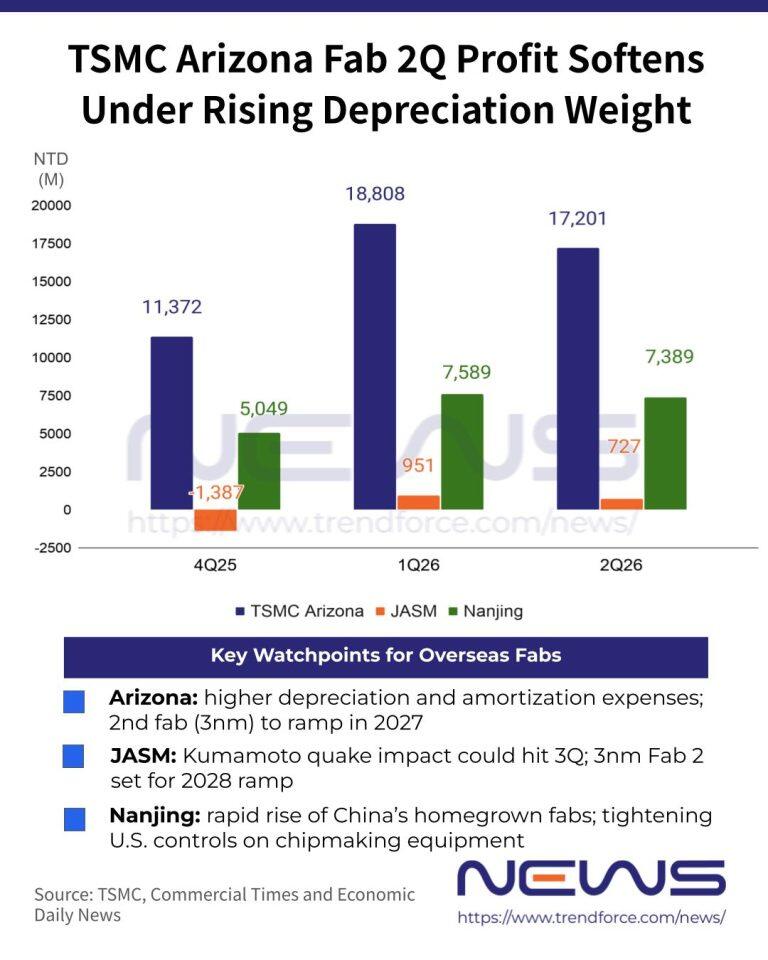
  As TSMC continues expanding its U.S. footprint, comments from Cliff Hou, TSMC Senior Vice President and Deputy Co-COO, have caught industry attention. According to Commercial Times, Hou said at the 2026 SelectUSA Investment Summit that the company “is prepared for growth from any new business opportunities,” remarks the market has interpreted as signaling potential further expansion of TSMC’s U.S. investments. TSMC’s total U.S. investment currently stands at US$165 billion.  Commercial Times notes that supply chain developments show chip equipment suppliers have also begun establishing U.S. subsidiaries to support TSMC. Industry sources added that TSMC’s total U.S. investment could reach as much as US$250 billion, with the company expected to replicate the Hsinchu Science Park cluster model in Phoenix.  Meanwhile, Economic Daily News reported that TSMC’s first Arizona fab entered mass production in 4Q24, while its second fab has already been completed and is expected to begin 3nm mass production in the second half of 2027. TSMC previously said construction of its third Arizona fab is already underway, while permits are being sought for a fourth fab and its first advanced packaging facility in the state. The report also noted that TSMC has acquired a second large parcel of land near its existing Arizona site to support future expansion plans.  Although TSMC’s U.S. fabs are more costly, capacity remains in strong demand, with previous reports indicating that customers had already reserved capacity at all four Arizona fabs, as noted by Economic Daily News. Institutional investors said that, for process technologies below 2nm, TSMC’s related capacity ratio between Taiwan and the U.S. is expected to reach roughly 7:3 by 2030.  TSMC Reshapes Board Amid Global Expansion  In addition, TSMC has also recently adjusted its board structure. According to Commercial Times, the company plans to revise its corporate charter by increasing the number of board seats from the current seven to ten directors to nine to twelve, with the proposal set to be discussed at the shareholders’ meeting on June 4.  The move reflects TSMC’s response to the rapidly changing global business environment and is intended to provide greater flexibility in recruiting directors from diverse professional backgrounds, the report said. It also noted that, as TSMC rapidly expands overseas and continues increasing its U.S. investments, the board will need more members with expertise in international supply chains, geopolitics, and U.S. policy.
2026-05-07 13:22 reading:166
Intense Competition in Advancing Processes at the 2nm by Samsung, Intel, and TSMC
  According to TechNews’ report, Gitae Jeong, Vice President of Samsung Electronics, recently revealed in an interview that the company is set to introduce the SF1.4 (1.4nm) process, expected to enter mass production in 2027.  This announcement intensifies the competition in advanced semiconductor manufacturing, particularly in the development of 2.5D/3D integrated heterogeneous structure packaging among the three major semiconductor foundry giants.  *TSMC: N3P Process Superior to Intel 18A, N2 to Lead Industry’s Advanced Processes  Previously, the semiconductor industry reported challenges with both TSMC and Samsung achieving yields above 60% for their 3nm processes due to undisclosed issues. TSMC’s yield was reported to be only 55%, below the normal yield rate.  However, TSMC’s President, C.C. Wei, expressed optimism, stating that current N3 demand is better than three months ago, contributing to a healthy growth outlook for TSMC in 2024.  Wei also anticipates that TSMC’s 3nm process will contribute a mid-single-digit percentage (4%-6%) to the company’s annual wafer revenue in 2023.  Regarding competition with rival Intel’s 18A process, Wei believes that TSMC’s N3P process offers better performance, power, and area (PPA), alongside improved cost efficiency and technical maturity. Furthermore, TSMC’s upcoming N2 process is expected to be the industry’s most advanced when introduced.  *Intel: Striving for the Fourth Customer for 18A Process Outsourcing Orders  Intel’s CEO, Pat Gelsinger, has revealed that the 18A process has secured orders from three customers and aims to acquire a fourth customer by the end of the year. The advanced 18A process is scheduled to begin production at the end of 2024, with one customer already having made an advance payment. External expectations suggest that the customer could possibly be NVIDIA or Qualcomm.  Intel has stated that Intel 4 and Intel 3 processes are similar, as are Intel 20A and Intel 18A processes. Consequently, Intel’s primary focus will be on offering Intel 3 and Intel 18A to semiconductor foundry customers. Meanwhile, Intel 4 and Intel 20A processes are more likely to be used internally. However, Intel is open to accommodating customer requests if they express interest in adopting these later processes.  *Samsung: Commencing Mass Production of SF2 in 2025, Prioritizing Internal Use  Due to challenges with the three-nanometer (3nm) manufacturing process, there have been reports that Samsung plans to shift directly to the more advanced two-nanometer (2nm) process.  According to Samsung’s Foundry Forum (SFF) plan, they will begin mass production of the 2nm process (SF2) in 2025 for mobile applications, expand to high-performance computing (HPC) applications in 2026, and further extend to the automotive sector and the expected 1.4nm process by 2027.  Similar to Intel, Samsung intends to prioritize the production of its own products using the 2nm process. The 2nm process products will initially be utilized for Samsung’s in-house products rather than external customer products.  *Summary  While TSMC’s N3 series currently enjoys broad support, including N3E, N3X, and N3P process series, the move to 2nm introduces new variables as it adopts a completely new GAAFET architecture. Regardless, whether it’s TSMC’s N2, Intel’s 18A, or Samsung’s SF2, each of them possesses its competitive strengths. The industry is also eagerly anticipating the future developments in advanced semiconductor processes.
2023-11-03 14:50 reading:2119
TSMC’s Capacity and Orders Surge, Is the Semiconductor Industry Bouncing Back?
  As reported by China Taiwanese media, there’s a gradual uptick in TSMC’s capacity utilization lately, accompanied by a noticeable surge in orders from TSMC’s clients. Some segments of the market are showing signs of rekindled demand, hinting at a possible upswing in the semiconductor industry. Nevertheless, certain semiconductor manufacturing firms remain cautious in their industry outlook.  TSMC’s Capacity Utilization Rate on the Rise  Media’s report indicates that TSMC’s capacity utilization rate has gradually recovered. The 7/6nm utilization, which had dropped to 40% at one point, is now around 60% and could potentially reach 70% by the end of the year. Similarly, the 5/4nm utilization is at 75-80%, and the 3nm capacity, which increases seasonally, is approximately 80%.  Concurrently, TSMC is experiencing a significant uptick in orders from their clients, including tech giants like Apple, MediaTek, NVIDIA, AMD, Intel, Broadcom, Marvell, and STMicroelectronics. Furthermore, AI chip clients such as AMD’s subsidiary Xilinx, Amazon, Cisco, Google, Microsoft, and Tesla have all accepted TSMC’s plan for a price increase in 2024.  Taking Tesla as an example, they are building a supercomputer facility in Austin to accelerate the development of their autonomous driving system, expanding the computing power of Dojo. The core D1 of Dojo is produced using TSMC’s 7nm process and advanced packaging technology. Based on this, Tesla is deepening its collaboration with TSMC, and it’s expected that their order volume will increase from around 5,000 pieces this year to 10,000 pieces next year.  Amid the ongoing AI surge, NVIDIA is actively seeking additional production capacity. On October 19th, NVIDIA’s CEO, Jensen Huang, revealed in an interview that the global demand for AI chips remains robust. He has met with TSMC’s CEO, C.C. Wei, to discuss providing more capacity to serve customers. NVIDIA is in the planning stages for the next generation of chips designed for AI-based infrastructure and has also engaged in discussions with partners such as Quanta and ASUS to strategize collaboration.  Is the Semiconductor Industry on the Rebound?  During TSMC’s Q3 earnings call, C.C. Wei pointed out that, in addition to strong AI demand, there’s a rebound in demand for smartphones and personal computers. As for automotive electronics, benefiting from the continued growth of electric vehicles, the demand for next year is expected to be quite robust. Regarding when the semiconductor industry might hit bottom, Wei remarked that there are some early signs appearing in the PC and mobile phone sectors. However, it remains challenging to predict a strong resurgence as customers are still cautiously managing their inventories.  In response to industry concerns about smartphone growth, TSMC’s CFO, Wendell Huang, noted that smartphone growth is anticipated to remain lower than the company’s future growth rate. High-Performance Computing (HPC) is expected to be the most robust growth segment, making substantial contributions to growth in the coming years.  On the other hand, other semiconductor foundry companies, such as PSMC, have also shared their perspectives on the fourth quarter and future industry developments. Recently, PSMC’s President, Brian Shieh, pointed out that the supply chain’s inventory seems to have reached a reasonable level, with growing demand for mobile panel driver ICs, surveillance system CIS chips, and visibility extending beyond one quarter. Prices for special memory products have started to show an upward trend. Demand for Power Management ICs (PMIC) also displays signs of recovery, even though the trend isn’t as pronounced as that of driver ICs and CIS chips.  Regarding UMC, the company is scheduled to hold an earning call on 25th October. In their previous earnings call for the last quarter, UMC mentioned that due to ongoing adjustments in the supply chain’s inventory, the outlook for wafer demand remains uncertain. Although the industry glimpsed a modest recovery in the second quarter, the overall sentiment in the end-market remains subdued, and customers continue to maintain stringent inventory management practices.
2023-10-25 11:18 reading:2177
  • Week of hot material
  • Material in short supply seckilling
model brand Quote
CDZVT2R20B ROHM Semiconductor
RB751G-40T2R ROHM Semiconductor
TL431ACLPR Texas Instruments
MC33074DR2G onsemi
BD71847AMWV-E2 ROHM Semiconductor
model brand To snap up
ESR03EZPJ151 ROHM Semiconductor
TPS63050YFFR Texas Instruments
STM32F429IGT6 STMicroelectronics
IPZ40N04S5L4R8ATMA1 Infineon Technologies
BU33JA2MNVX-CTL ROHM Semiconductor
BP3621 ROHM Semiconductor
Hot labels
ROHM
IC
Averlogic
Intel
Samsung
IoT
AI
Sensor
Chip
About us

Qr code of ameya360 official account

Identify TWO-DIMENSIONAL code, you can pay attention to

AMEYA360 weixin Service Account AMEYA360 weixin Service Account
AMEYA360 mall (www.ameya360.com) was launched in 2011. Now there are more than 3,500 high-quality suppliers, including 6 million product model data, and more than 1 million component stocks for purchase. Products cover MCU+ memory + power chip +IGBT+MOS tube + op amp + RF Bluetooth + sensor + resistor capacitance inductor + connector and other fields. main business of platform covers spot sales of electronic components, BOM distribution and product supporting materials, providing one-stop purchasing and sales services for our customers.

Please enter the verification code in the image below:

verification code